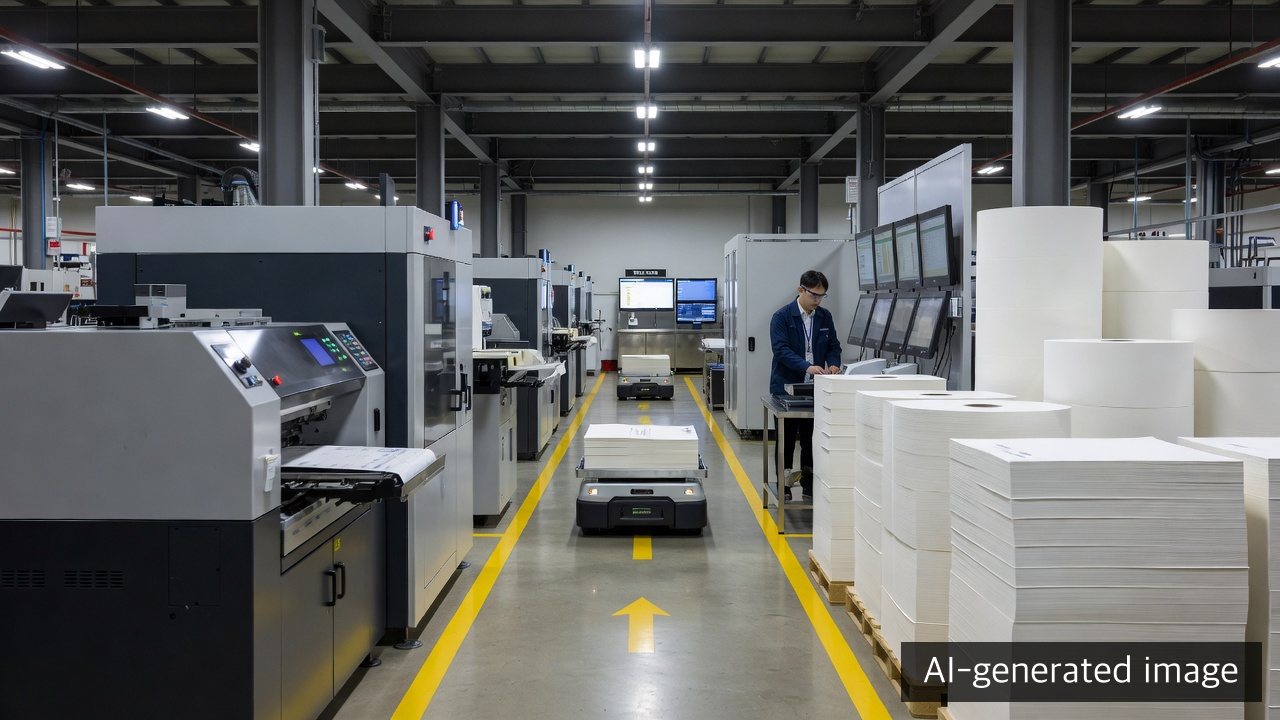
In high-mix, low-volume printing, automation does not begin with a robot or an autonomous guided vehicle. It begins by turning each order’s design, quantity and specification into production-ready data, then keeping that data connected through prepress, approval, printing, finishing and dispatch.
Prinpia Digital Center provides a clear example of that dependency chain. Samsung Electronics’ official smart-factory case study says Prinpia connected web ordering, editing, inspection, production and dispatch through an MES-based integrated system. It also introduced Data Matrix-based automation for print alignment and cutting-dimension entry, inter-floor logistics with AGVs, and automated palletising. A later Korea Economic Daily report described online order data moving directly into production and completed books travelling to the warehouse by AGV.
The public sources list confirmed systems and outcomes, but they do not publish a detailed project chronology. This article therefore separates the reported facts from an operations-based implementation sequence reconstructed from the dependencies between data and physical flow.
Separate confirmed facts from operating interpretation
| Area | Confirmed in public sources | Operating interpretation |
|---|---|---|
| Business challenge | Short runs, many variants, short lead times, manual process control, file errors and inefficient logistics | Conventional mass-production efficiency alone cannot solve the problem |
| Order connection | Web-ordering system linked to MES | Remove order re-entry before automating physical handling |
| Production control | Editing, inspection, production and dispatch digitised with real-time process control | One job identity must persist across every process |
| Quality | Data Matrix used to automate alignment and cutting-dimension input | Quality criteria and process settings must travel with the job |
| Logistics | AGVs automate inter-floor transport | Location, completion and move-request data must be reliable first |
| Packing | Automated palletising introduced | Handling units and pallet standards must be stable |
| Published outcome | Samsung’s case reports about KRW 700 million in annual savings and 233% sales growth over two years | Company case values; they do not isolate automation as the sole cause |
The Korea Economic Daily reported that the Digital Center, completed in 2023, generated KRW 2.4 billion in its first year, KRW 4.0 billion in 2024 and KRW 8.0 billion in 2025. These figures show growth, but the public data do not separate the effects of automation from market demand, sales activity, product mix or service expansion. A manufacturer should therefore build its own case around output, defects, delivery, work in process and handling time, rather than copying Prinpia’s growth rate.
Stage 0: Define which orders enter the automated flow
Before opening web ordering, define which orders can pass through a standard automated route. Books, business cards, leaflets and stickers have different file, paper, colour, finishing, inspection and packing requirements.
Standardise at least the following for each product family:
- available combinations of size, quantity, paper, print and finishing;
- accepted file formats, resolution, bleed and font treatment;
- the boundary between automatic quotation and manual review;
- identification of job number, file revision and approved master;
- process, changeover and subcontracting time used in lead-time calculation; and
- packing unit, pallet format, storage and dispatch conditions.
A web portal with unlimited options becomes an exception-handling portal, not an automated order channel. Start with a constrained set of repeatable products.
Stage 1: Convert web-order data into a production instruction
The core of web ordering is not the screen. It is the data structure. The customer’s selected specification must become a production instruction without being reinterpreted or typed again by an operator.
Required links include:
- customer order number to internal job number;
- approved artwork file and revision;
- size, quantity, stock, colour and finishing specification;
- due date and dispatch method;
- inspection hold, re-upload and cancellation status; and
- agreement between quoted conditions and the actual production specification.
The first KPIs should not be order count. Measure re-entry rate, file-resubmission rate, missing-specification rate and pre-production hold time. If an operator still copies each web order into a spreadsheet, the foundation of automation has not been established.
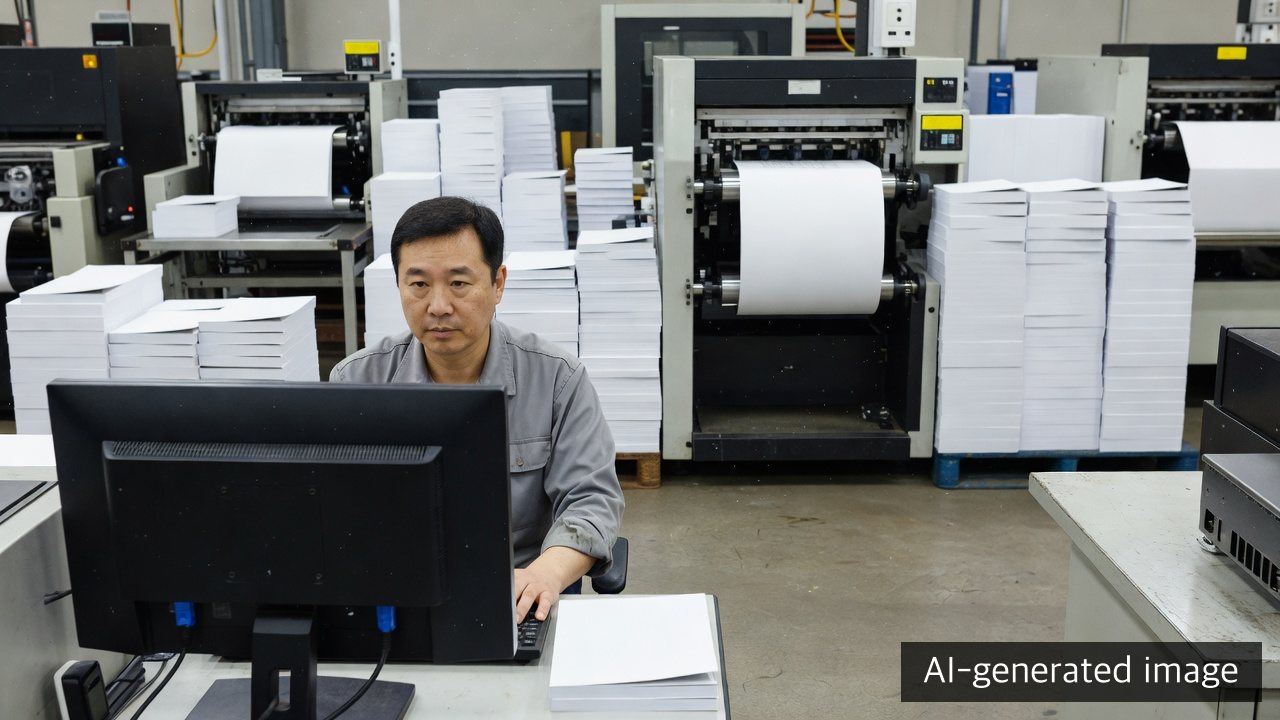
Stage 2: Make MES the single operating record for job, status and output
MES should not be only a machine-monitoring dashboard. It must connect the order to the actual operation. The same job number should identify whether work is in prepress, approval, printing, binding or finishing, packing, warehouse receipt or dispatch.
Minimum status model
| Status | Completion condition | Data passed downstream |
|---|---|---|
| Artwork received | Required files and specification present | File revision and order specification |
| Prepress complete | Production file generated | Print settings, imposition and cutting information |
| Inspection approved | Approved master matches production file | Approver, timestamp and revision |
| Printing complete | Planned and good quantities confirmed | Good, loss and rework quantities |
| Finishing complete | Binding, folding, cutting or other finishing passed | Finished quantity and defect code |
| Packing complete | Pack unit and identification verified | Box and pallet identity |
| Warehouse receipt | Location and quantity confirmed | Stock location and release status |
| Dispatch complete | Handover to carrier confirmed | Shipped quantity and transport record |
Data that cannot initially be captured from equipment should still be easy for an operator to enter accurately. Too many fields destroy compliance; too few fields hide bottlenecks and defect causes.
Stage 3: Embed quality conditions and traceability into the route
Prinpia’s use of Data Matrix to automate print registration and cutting-dimension entry is significant. The priority is to connect the correct file, correct settings and correct finishing operation before attempting to maximise speed.
A quality-data layer should cover:
- automatic comparison of job number and artwork revision;
- retrieval of stock, size, imposition and cutting dimensions;
- first-off approval and retention of the approved master;
- good, defective and rework quantity by process;
- defect type and originating process; and
- linkage between a reprint and its original job.
The objective is not to remove every human inspection. Human judgement may remain necessary for colour, appearance and binding quality. The system should first block repeatable errors such as the wrong file or a mistyped cutting dimension.
Stage 4: Add AGVs after completion and location signals are stable
An AGV automates movement, but an upper-level system must decide what moves, when it moves and where it goes. Public reports describe Prinpia’s AGVs handling inter-floor logistics and working with a freight elevator. Maeil Business Newspaper reported AGVs following QR-based routes and carrying approximately 1.5 tonnes of material in the observed operation.
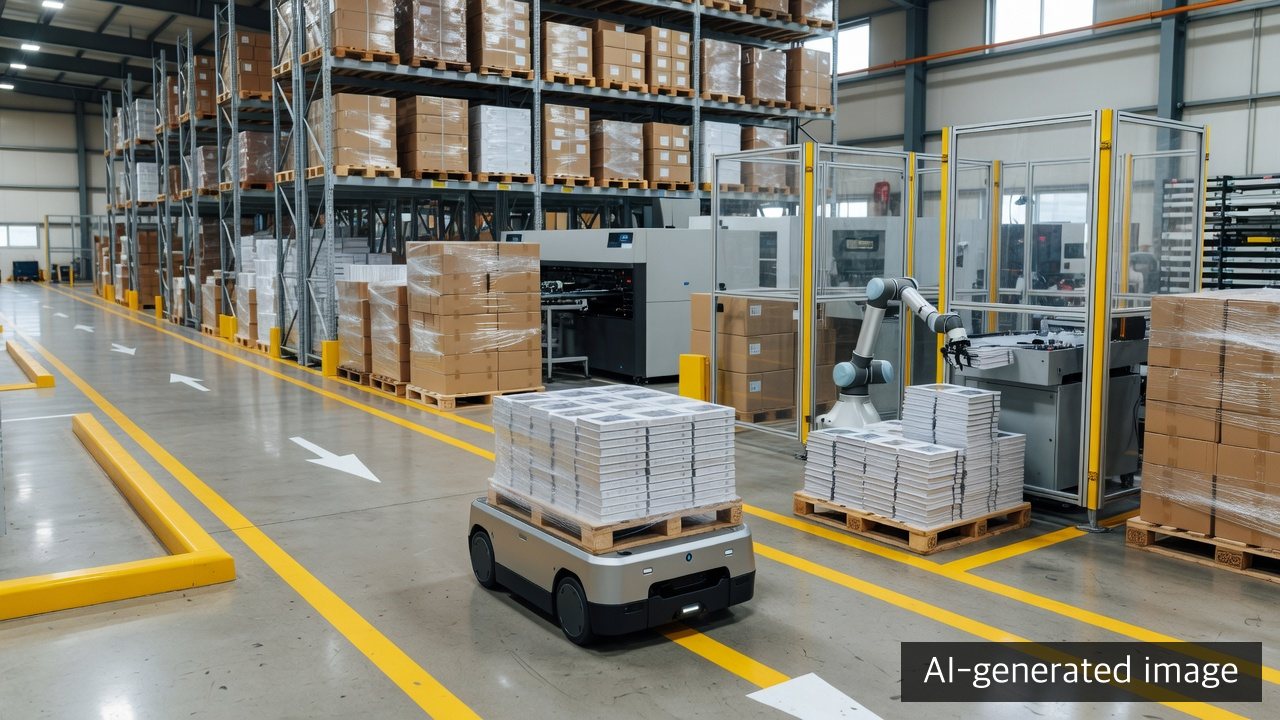
Define these interfaces before procurement:
- handling unit and maximum weight and dimensions;
- identification of origin and destination locations;
- process-complete, quality-hold and move-request signals;
- interfaces to freight elevators, automatic doors and charging stations;
- physical separation of AGVs, forklifts and pedestrians;
- recovery from obstruction, communications loss or elevator failure; and
- conditions and authority for switching to manual transport.
Useful KPIs are call waiting time, transport completion time, process queue, manual interventions and causes of safety stops. If completion data arrive late or location data are wrong, an AGV can accelerate confusion.
Stage 5: Close the order loop through warehouse, storage and palletising
Prinpia was also reported to offer storage services for small publishers and independent authors. That model shows that production completion is not necessarily order completion. Storage, stock, partial dispatch and remaining quantity must stay linked to the original order.
Controls should cover:
- separated locations for finished, held, returned and rework stock;
- verification of box, pallet and quantity identity;
- separation of customer-owned and company-owned inventory;
- remaining quantity and retention period after partial shipment;
- stock rotation or customer-specific dispatch priorities;
- pallet pattern, stack height and rack load; and
- replanning after cancellation or address change.
Warehouse automation is not merely the final machine. It is the last data segment of the order. If dispatch confirmation and stock deduction do not agree with web-order and MES records, the customer-facing order status will also be wrong.
Stage gates and KPIs
| Stage | Release condition | First KPIs |
|---|---|---|
| 0. Product and option standardisation | Automated scope and exception rules approved | Exception-order share, demand by option |
| 1. Web ordering | Job created without re-entering order data | Re-entry, file resubmission, hold time |
| 2. MES | All processes use one job identity and status model | On-time delivery, queue time, WIP |
| 3. Quality data | Master, settings and defects linked to the job | First-off rejection, rework, defect rate |
| 4. AGV | Completion, location, move signals and safety route verified | Call wait, manual intervention, safety stops |
| 5. Warehouse and dispatch | Physical quantity and location match system stock | Inventory accuracy, pick time, dispatch error |
Pilot before full rollout
One safe starting point is one product family, three to five representative order types, one production line and one transport route. The eight-week structure below is an example schedule that should be adjusted to site conditions.
- Week 1: Fix the order-option, exception and job-number model.
- Weeks 2–3: Generate MES jobs from web-order data and reconcile them manually.
- Week 4: Connect prepress, approval, production results and defect codes.
- Weeks 5–6: Trial AGV movement in limited periods and repeatedly test manual fallback.
- Week 7: Run an end-to-end test including warehouse location, partial dispatch and stock deduction.
- Week 8: Compare delivery, defects, WIP and handling time before deciding whether to scale.
Stage gates matter more than the calendar. Delaying downstream hardware when upstream data are unstable can shorten the total programme.
Three claims to avoid
First, Prinpia’s sales growth cannot be attributed to automation alone. Independent-publishing demand, sales execution, product expansion and storage services may also have contributed.
Second, deploying MES, AGVs and collaborative robots does not create an unmanned factory. Process design, exception handling, quality judgement, maintenance and safety management remain essential.
Third, public success figures should not be used as the payback model for another plant. Measure the current definitions of output, labour time, defects, WIP, handling, warehouse activity and dispatch errors, then compare improvements using the same definitions.
Conclusion
The most important feature of the Prinpia case is not one AGV or collaborative robot. It is the sequence in which web ordering creates the job, MES controls status and output, quality data prevent mismatches, and AGVs and warehousing close the physical loop.
Before requesting equipment quotations for high-mix print or packaging automation, draw the starting point of order data and the final point of the job identity. Automation hardware can move toward the same operating goal only when the data can follow the job.
About the Author
PackingMaster: Editor of PaperPackLog. Covers market trends, product insights, and technology in the paper packaging industry.
References
- Samsung Electronics Smart Factory Support Program, “Innovation in the Printing Industry: Prinpia’s New Leap with a Smart Factory,” 2 July 2026, https://www.samsung-smartfactory.com/media/case-by-industry/5101
- Korea Economic Daily, “A Printing Plant Once Thought to Be Failing Draws Young Workers as Sales Surge,” 25 July 2026, https://www.hankyung.com/article/202607169753i
- Maeil Business Newspaper, “AGVs and Automated Processes: ‘A Finished Book in Three Hours,’” 14 April 2026, https://www.mk.co.kr/news/business/12016650
- Korea Federation of SMEs, “Site Visit to a Win-Win Smart Factory with National Assembly Reform Action Forum Members,” 11 March 2026, https://www.kbiz.or.kr/ko/contents/bbs/view.do?seq=162406&mnSeq=207
Sources checked on 14 August 2026. Published outcomes are company and programme case values. This article reconstructs an implementation dependency sequence from publicly confirmed components and does not claim that the sources provide a detailed project chronology.