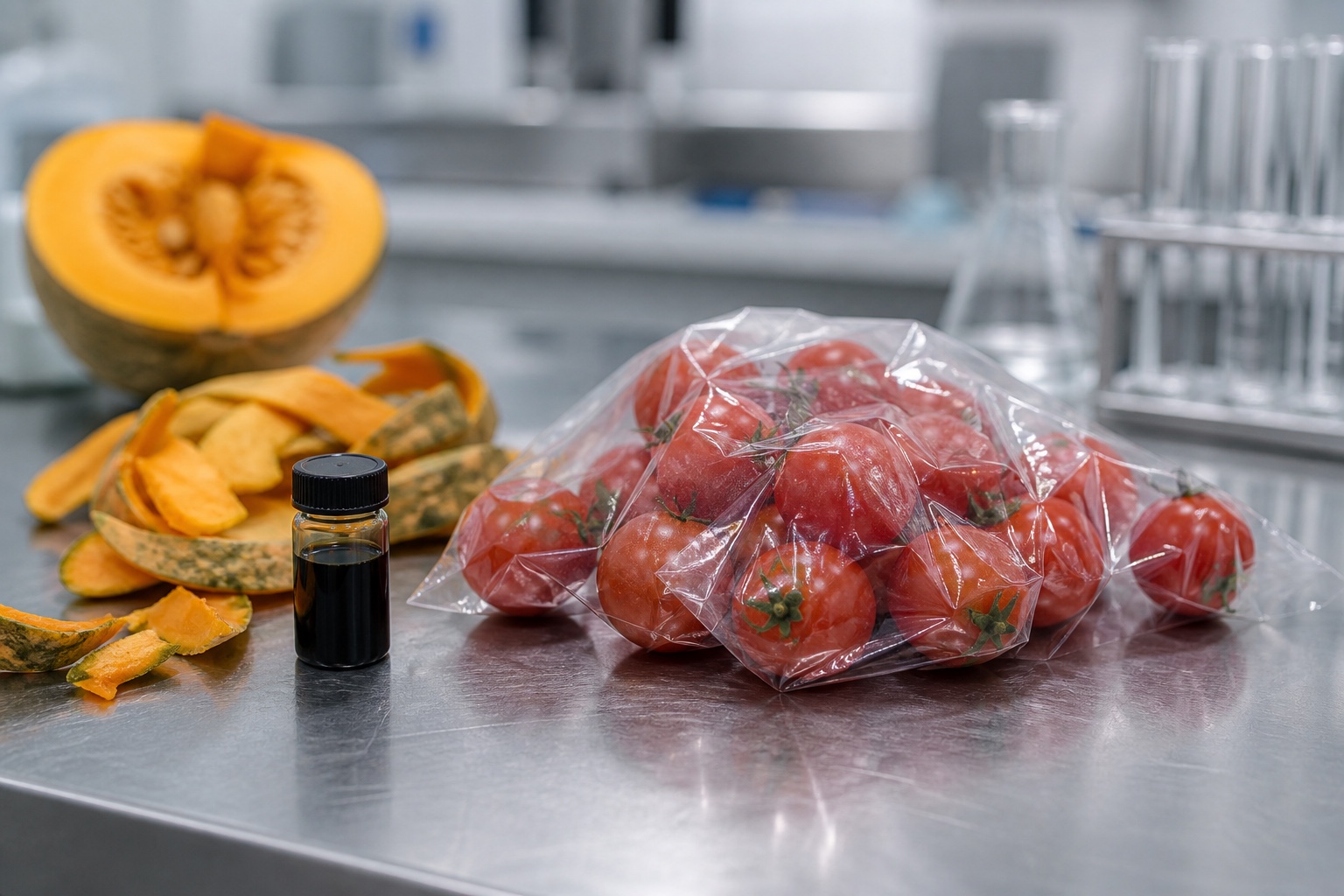
A report that a pumpkin-peel carbon quantum dot (CQD) film stored cherry tomatoes for 25 days is not enough to approve a food-contact specification. The paper’s abstract confirms mechanical, UV-barrier, water-vapor-barrier, antioxidant and tomato-preservation results for a carboxymethyl cellulose/gelatin film. Food-contact migration, actual dietary exposure, continuous coating, sealing, printing and end-of-life performance still require separate evidence. The active-film commercialization checklist below separates research findings from release approval.
What Material Was Actually Tested
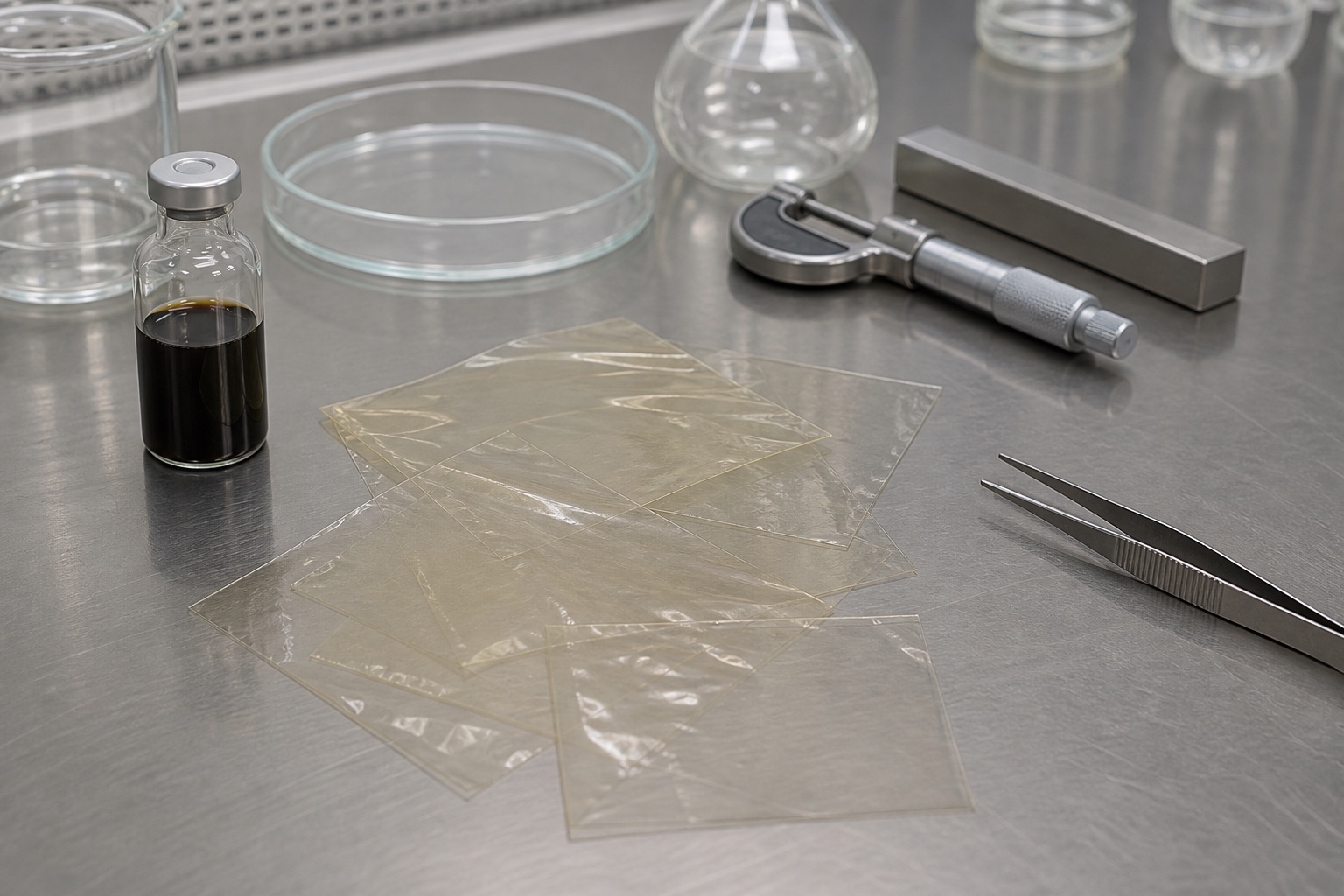
The Food Research International study synthesized CQDs from pumpkin-peel waste by a hydrothermal method and embedded them in a carboxymethyl cellulose (CMC)/gelatin (Gel) composite. The paper abstract and a July 24 science report support the following boundaries.
| Item | Directly reported | Safe interpretation |
|---|---|---|
| Matrix | CMC/gelatin composite film | Do not generalize to paper or mono-material film |
| CQD feedstock | Pumpkin-peel waste, hydrothermal synthesis | A waste-utilization route; not a complete process LCA |
| CQD addition | Multiple concentrations; the 3% film is prominent in results | Not a commercially approved optimum formulation |
| Tensile strength | 78–147% higher than the control | Concentration-dependent; not a package-failure guarantee |
| UV blocking | 72.5±1.3% UV-A and 94.3±2.1% UV-B for the 3% film | Comparable only under the same specimen, method and thickness |
| Water-vapor permeability | 12.32% lower | Distribution humidity, condensation and perforation still require testing |
| Contact angle | Increased 12.87–26.14% with CQDs | A surface-wettability signal, not a waterproof certification |
| Antioxidant indicator | 88.58% DPPH activity for the 3% film | Not the same as a shelf-life extension percentage |
| Microbial resistance | The abstract says the formulations did not show strong resistance to microbial pathogens | Do not market it as confirmed antimicrobial packaging |
| Cell assay | Non-toxic below 2mg/mL in Caco-2 cells | Not a complete food-contact or dietary-safety approval |
A key cross-check matters here. The Asian Scientist story broadly describes antimicrobial improvement, while the paper abstract says the tested formulations did not show strong resistance to microbial pathogens. This article therefore separates the confirmed antioxidant and UV-barrier results from unresolved antimicrobial performance.
What the 25-Day Cherry-Tomato Result Means
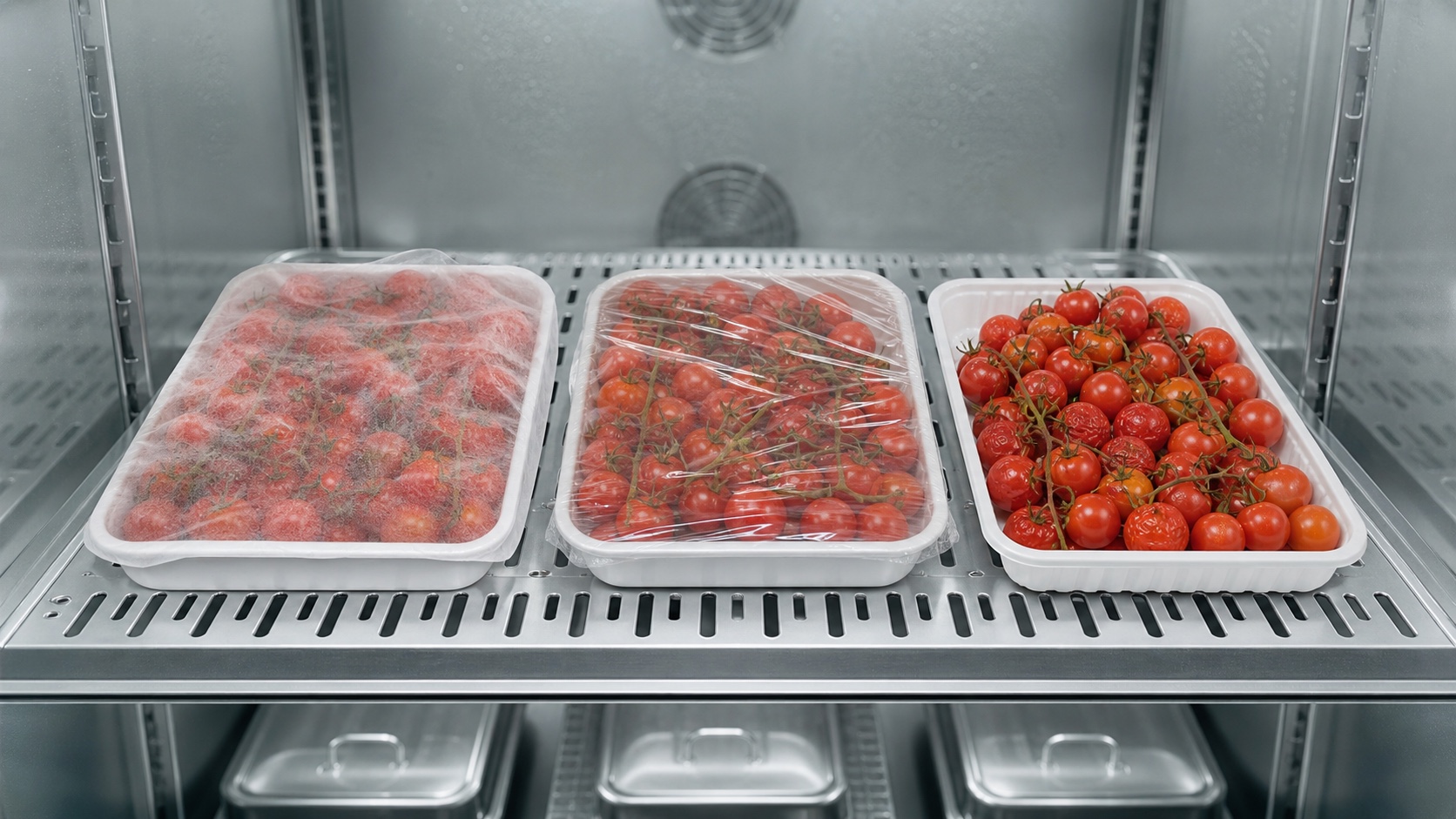
The secondary report says cherry tomatoes were stored for 25 days in the new material and compared with plastic-wrapped and unpackaged controls. Tomatoes in the new material showed less weight loss and softening and lower microbial growth than the controls. The paper abstract independently says cherry tomatoes packaged in the 3% CQD composite showed the best quality preservation among the tested formulations.
The 25-day period cannot become a universal commercial shelf-life claim. Cultivar, ripeness, temperature, humidity, package area, perforation, gas composition, film thickness, seal structure and acceptance criteria can change the outcome. The report mentions a film around 0.01mm thick, but it does not establish commercial thickness capability or packaging-machine compatibility.
Four Gates from Research Film to Commercial Package
1. Lock Formulation and Batch
Record pumpkin-peel pretreatment, hydrothermal conditions, CQD size and surface chemistry, CMC and gelatin grades, loading, solids and drying conditions. Agricultural by-products can vary by season and lot, so CQD yield and functional variation require control.
2. Establish Food-Contact Safety
A cell-viability test alone does not establish compliance. Evaluate overall and specific migration, residual reactants, impurities, nanoparticle transfer, expected dietary exposure, food type, contact time and temperature, and the data required by the relevant authority. Washing or peeling produce cannot replace the packaging-material assessment.
3. Reproduce Converting and Preservation
Assess continuous coating or casting, thickness variation, blocking, printing, bonding or sealing, flexing, friction, dust and line speed. Use the real product with defined controls and replication, linking temperature/humidity history, weight loss, firmness, color, microbiology, sensory results and package failure under one study ID.
4. Verify End of Life and Economics
“Biodegradable” does not mean rapid disappearance in every environment. Separate composting, anaerobic digestion, incineration and recycling routes. If the gelatin/CQD composite enters paper recycling, test screen reject, stickies and wastewater effects. Compare collection, drying, synthesis, purification and film-making energy and cost on the same functional basis as the incumbent package.
Copy-Ready Active-Film Commercialization Checklist
| Gate | Conditions to enter | Evidence required | Public status | Decision and action |
|---|---|---|---|---|
| Formulation and batch | CQD lot, synthesis, CMC/Gel grades, loading, thickness | TDS/COA, batch record, size/surface analysis, thickness map | Research formulation reported; manufacturing window undisclosed | Proceed to pilot only after functional results reproduce across lots |
| Food contact | Food type, contact time/temperature, area, expected exposure | Migration, impurities, toxicology, exposure and regulatory review | Partial cell-assay result only | Hold direct food-contact use until required evidence is complete |
| Converting | Coating, drying, slitting, print, seal and line-speed conditions | Pilot roll, defect/thickness records, seal window, downtime log | Not reported publicly | Scale only after continuous running and sealing on the actual machine |
| Preservation | Cultivar/ripeness, environment, controls, replication, dates | Raw data, image IDs, weight, firmness, microbiology, sensory results | 25-day tomato comparison and paper result reported | Hold shelf-life wording until reproduced in the target route |
| End of life and cost | Recovery route, synthesis yield, energy, material and disposal cost | Recycling/composting test, mass balance, cost sheet | Not public | Compare against the incumbent package on the same function |
Conditions That Require a Hold
- Extending the 25-day trial to every produce category
- Converting a 147% tensile increase into a package-failure reduction claim
- Describing DPPH antioxidant activity as confirmed antimicrobial performance
- Treating the Caco-2 assay as food-contact approval or proof of human safety
- Omitting CQD migration and expected dietary exposure
- Failing to connect laboratory thickness to continuous-production variation
- Making a general “eco-friendly” claim without a defined biodegradation or recycling route
The study is a useful starting point: pumpkin-peel CQDs improved mechanical, UV-barrier, water-vapor-barrier and antioxidant indicators in a CMC/gelatin film and showed promise in cherry-tomato preservation. The abstract also reports no strong antimicrobial resistance, and the researchers say safety and regulatory limits still need optimization. Commercial approval should follow only after formulation, migration and toxicology, real converting, target distribution and end of life are demonstrated in one controlled pilot.
About the Author
PackingMaster: Editor of Paper Pack Log. We collect and organize market trends, product information, and technical insights for the paper packaging industry.
References
- Kavindi et al., “Development of active food packaging using carboxymethyl cellulose/gelatin composites reinforced with carbon quantum dots derived from pumpkin peel waste,” Food Research International 237 (2026), 119344
- Asian Scientist, “Pumpkin Peel Powers Packaging That Keeps Food Fresher For Longer” (July 24, 2026)