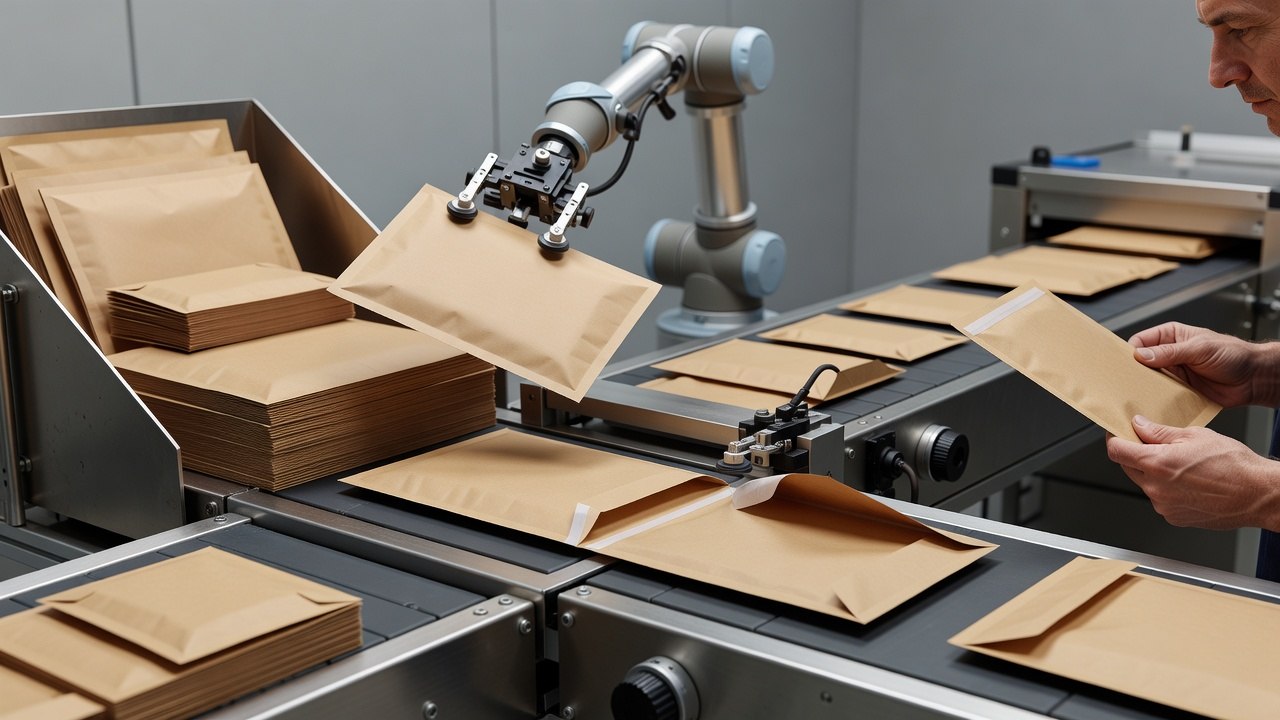
RRD introduced the VersaPac FastTrack Paper Mailer on August 20, 2026. Reports describe a non-padded paper mailer with a paper peel-and-seal closure, compatibility with robotic vacuum handling and a fast-bonding adhesive. RRD says the design avoids silicone-coated plastic release strips and is intended for curbside recycling. Public materials do not disclose basis weight, coating and adhesive composition, size-specific strength, seal windows, independent recyclability testing or achieved line throughput.
What Is Different
Conventional paper-and-bubble mailers provide cushioning but combine materials that can be difficult to separate. VersaPac FastTrack moves toward a flat, non-padded structure and paper-based closure. RRD also says the lower empty volume may reduce dimensional-weight exposure. Products that require cushioning may still need an insert or another package format.
| Reported feature | Operational meaning | Condition not publicly disclosed |
|---|---|---|
| Non-padded paper mailer | Potential fit for apparel and other low-cushioning products | Recommended load, sharp-edge risk and size-by-size dimensions |
| Paper peel-and-seal closure | Direction to reduce plastic release strips | Adhesive chemistry, peel strength and temperature/humidity window |
| Robotic vacuum compatibility | Material and flatness designed with automated pickup in mind | Cup, speed, stack height, static and double-pick conditions |
| Fast-bonding adhesive | Intended for high-velocity packing | Compression time, strength development and tamper behavior |
| Curbside-recycling intent | Designed for a paper collection stream | Local acceptance, repulping yield, screen reject and stickies |
| SB 54 alignment | Plastic-reduction positioning | Product-specific legal conclusion and independently measured EPR effect |
Where Automated Mailers Fail
“Paper” does not automatically mean automation-ready. Stack curl, moisture, surface friction and static can cause a vacuum gripper to miss or lift two pieces. Incomplete opening lets the product catch and tear an edge. Dust or wrinkles in the seal area can produce a weak closure.
A validation cycle should cover the full sequence:
- Singulate one mailer from the magazine.
- Pick it at the specified position and transfer it.
- Open the mouth and insert the product.
- Remove the release element and align the flap.
- Seal at controlled pressure and time.
- Apply the label, check weight and sort for shipment.

Six Validation Gates
1. Product Fit
Classify product mass, edges, friction, compression sensitivity and cushioning need. A non-padded format should be compared with inserts or another mailer when puncture, crushing or impact is credible.
2. Feeding and Vacuum Pickup
Measure curl, flatness, friction, static, vacuum leakage and double picks by size. Lock vacuum-cup material and diameter, pick point, acceleration and magazine pressure.
3. Opening and Insertion
Verify that the mouth opens repeatedly and that the product does not snag or tear the edge. Record product clearance, opening device and insertion speed together.
4. Sealing
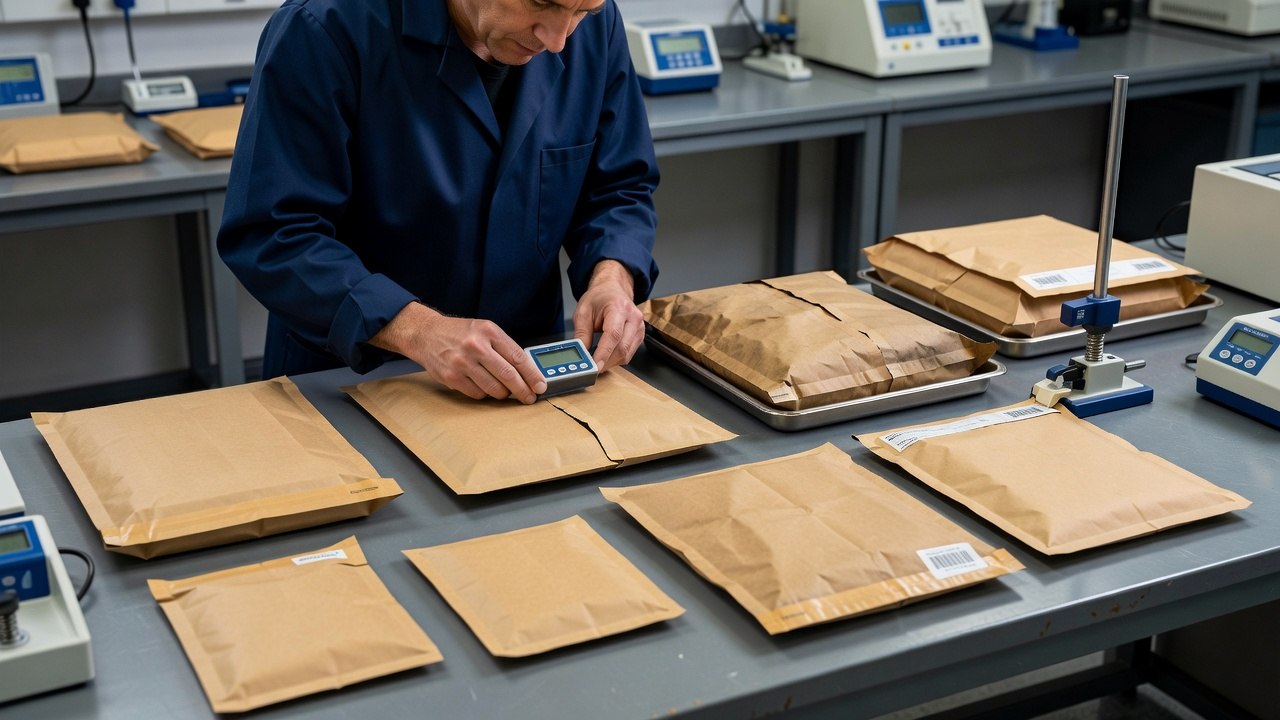
Compare seal-area cleanliness, pressure and dwell time, immediate peel, 24-hour peel, and low-, high-temperature and high-humidity conditions. Do not turn “fast bonding” into a line-rate or seal-yield result without data.
5. Distribution and Labels
After drop, vibration, compression, abrasion, rain and condensation exposure, inspect tear, opening and label loss. RFID or liner-free label compatibility must be qualified on the chosen label, printer and reader combination.
6. Collection and Recycling
Confirm instructions in the destination market and evaluate the actual construction for repulpability, fiber yield, screen reject, stickies and wastewater effects. Paper-based is not the same as accepted in every curbside system.
Copy-Ready Line Approval Table
| Stage | Values to record | Minimum evidence | Hold condition |
|---|---|---|---|
| Incoming material | Size, basis weight, moisture, curl, friction and adhesive lot | TDS/COA and lot sampling | Basic specification and tolerance unknown |
| Pickup | Vacuum, cup, position, speed and double picks | Consecutive-cycle success and stop log | Repeated miss by size or humidity |
| Open and insert | Clearance, opening and product orientation | Snag, tear and incomplete-insertion data | Only manual packing succeeds |
| Seal | Pressure, time, environment and peel | Initial/aged seal strength and opening rate | Only a fast-bond claim exists |
| Distribution | Load, environment, drop and vibration | Tear, puncture, seal and label results | Real route not reproduced |
| Recycling | Market, construction and mill route | Repulping, reject and stickies data | Company-level claim only |
Claims That Require a Hold
- Extending robotic-handling design to every machine, size and line rate
- Treating curbside-recycling intent as acceptance by every local facility
- Converting lower empty volume into a product-specific freight saving
- Using SB 54 positioning as legal advice or an EPR-cost exemption
- Ignoring adhesive and coating effects because the closure is paper-based
VersaPac FastTrack is an interesting direction for reducing plastic release strips and mixed-material mailers while considering automated fulfillment. Adoption should depend on whether single-piece pickup, opening and insertion, seal retention, distribution protection and local recovery reproduce for the same SKU on the same line.
About the Author
PackingMaster: Editor of Paper Pack Log. We collect and organize market trends, product information, and technical insights for the paper packaging industry.