
Does choosing a low-migration ink approve every food package made with it? No. In an October 13, 2026 announcement, Sun Chemical says its upgraded SolarFlex FSP UV flexographic ink range meets or surpasses requirements of the German Ink Ordinance (GIO) and Swiss Ink Ordinance (SIO), describes GIO as an upcoming regulation, and reports migration and odour assessments in customer trials in Europe. Those are manufacturer statements about a product range and trials, not independently reviewable approval of every finished package, food type or use condition.
Read the announcement at the level of evidence it supplies
The company also describes low odour and viscosity, fast curing, printability and a range of colour options. It says trials with key label and packaging customers included migration testing and odour assessments at printing speeds above 200 metres per minute. Neither the reviewed company release nor The Packman’s report names the laboratory, tested laminate or printed pack structure, food or simulant, contact time and temperature, substances and detection limits, measured migration results, acceptance criteria or an actual finished-pack design. A statement that tests succeeded is not publication of their independently assessable results. The trade item closely follows the company’s claims and does not supply its own migration measurement.
| Statement in the announcement | What can be recorded | What cannot be inferred |
|---|---|---|
| Meets or exceeds GIO (described by Sun Chemical as upcoming) and SIO requirements | Sun Chemical’s account of its formulation and selected raw materials | Current regulatory approval for every structure or jurisdiction |
| Customer migration and odour assessments | Company’s assertion that trials occurred | Independent laboratory validation or a zero-odour guarantee |
| Printing at more than 200 m/min | Claimed test-speed condition in certain customer trials | Equal curing and migration results on any press or substrate |
| Use in labels, sleeves and packaging | Manufacturer’s proposed fields of application | Permission for direct food-contact printing or universal finished-pack safety |
The GIO/SIO wording is attributed to Sun Chemical; this article does not adjudicate the provisions or a particular converter’s compliance. Its broad energy-curable printing product page introduces the SolarFlex family, but the page’s descriptions of other branded ink lines cannot be substituted for a SolarFlex FSP-specific test dossier.
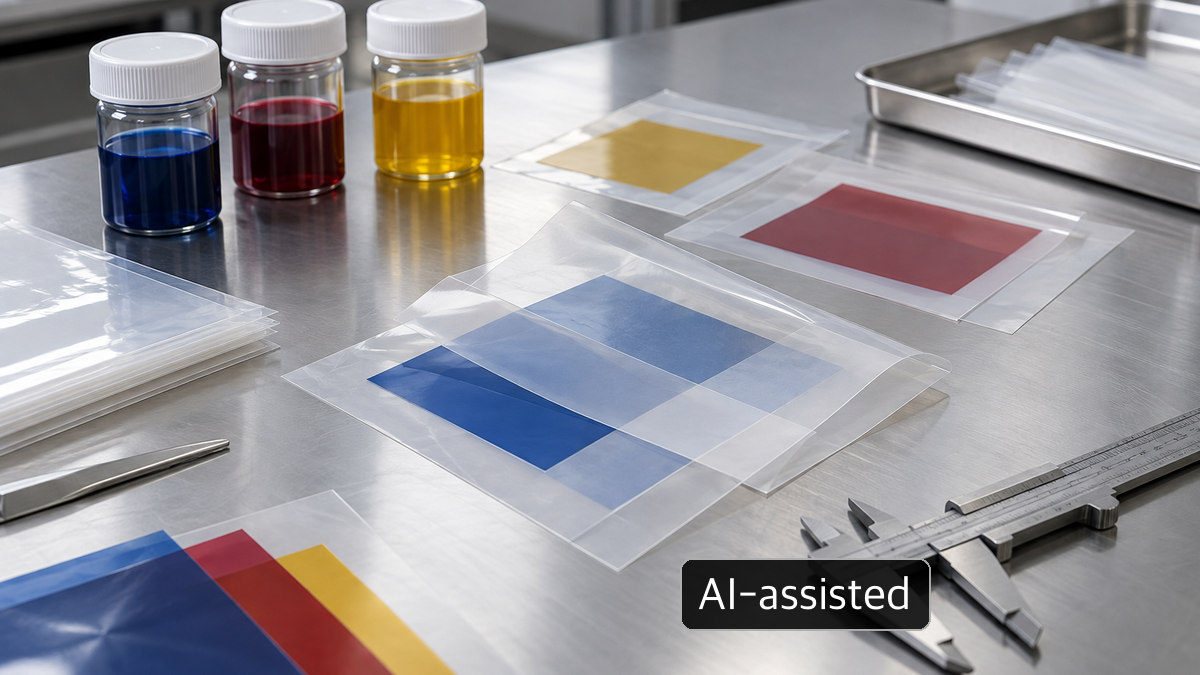
Ink formulation and finished-article fitness are separate questions
The European Commission’s overview of food-contact legislation distinguishes framework safety and inertness principles from good manufacturing practice. It describes the objective that food-contact materials should not transfer constituents at levels harmful to health or unacceptably change food composition, taste or odour. This regulatory overview is not a SolarFlex FSP certification or a result for a converted pack. The assessment must address the article as actually manufactured and used.
Even where the printed face of a label is not intended to touch food, the question depends on the actual food-contact layer, substrate, adhesive or coating, lamination and seals; on face-to-face set-off during winding or stacking; and on food type, storage time, temperature and UV-curing conditions. These are variables to investigate—not evidence that migration has occurred in this ink, or that the ink is cleared for direct food contact. Nor does a non-food-contact-side designation itself make verification unnecessary.
What evidence should a converter request before a pack-specific decision?
The reviewed reports do not provide a named customer’s complete layer structure, exposed surfaces, primary analytical result or independent assessment. Do not promote the release into a suitability verdict for a particular paper tray, film label, sleeve or packaged food. Request the following linked dossier for the actual intended article:
- Construction and use: Drawing identifying printed and food-contact faces, the ink and varnish versions, substrate, adhesive and all layers, the food, storage time and temperature, and intended sales market.
- Migration and sensory report: Finished-pack sample and lot, cure and winding conditions, method and simulant, analytes and limits, numerical results, laboratory identity and report date.
- Press reproducibility: Equipment and UV dose/cure conditions for the manufacturer’s reported >200 m/min trials versus the intended press, including a defensible worst-case production condition.
- Change control: Requalification triggers for colours, ink lots and formulation, overprint varnish, substrate, adhesive and winding/stacking geometry.
- Applicable compliance decision: An appropriately reviewed assessment tied to the destination rules, client specification and exact pack—not merely an ink leaflet or a republished company release.

The announcement describes an interesting development direction, but the reviewed public record offers no numerical migration dossier that an outside reader can reconcile with a disclosed actual pack structure. A pack-specific approval or adoption recommendation therefore remains on hold pending evidence. This limitation does not prove the ink unsafe; it prevents an unsupported claim that the finished packaging has passed.
About the Author
PackingMaster: Editor of PaperPackLog, covering paper-packaging industry developments, products and technical decisions.