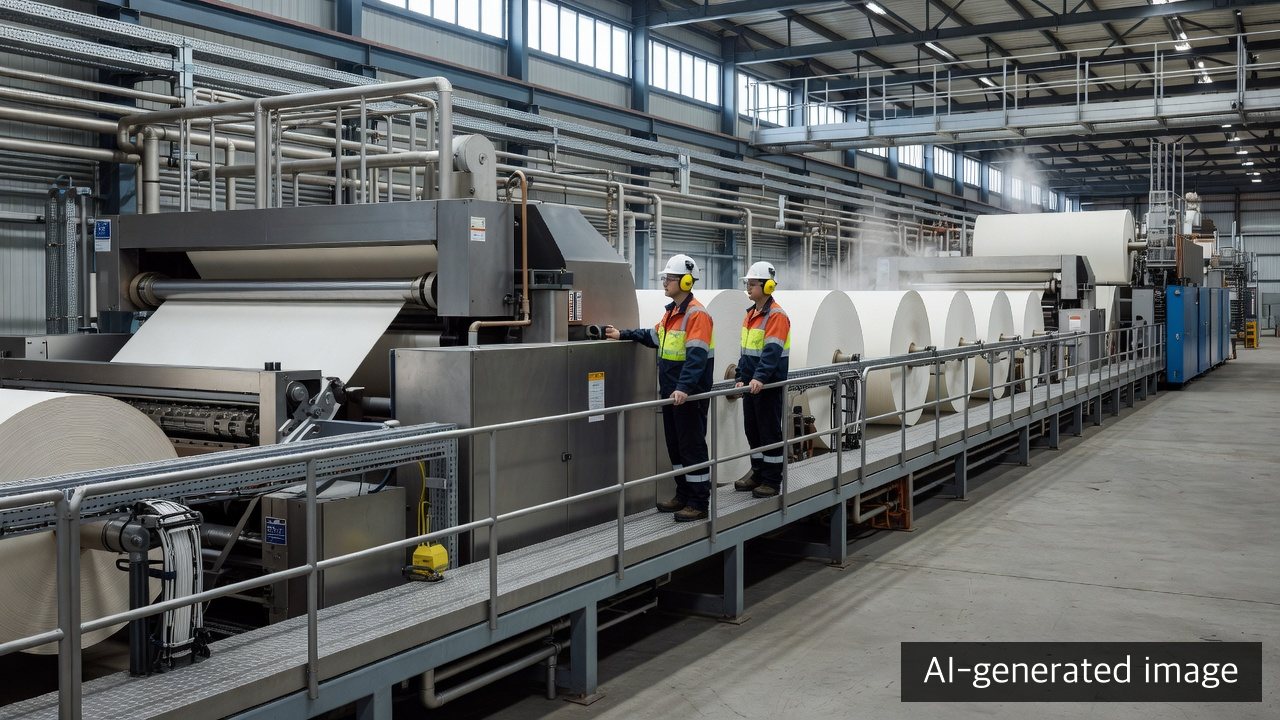
According to Voith’s September 17, 2026 release, Sun Paper’s PM47 in Yanzhou, Shandong Province, China, reached 1,300 m/min during its first week after start-up and 1,400 m/min on day 10. The machine has an 8.66 m wire width and an annual design capacity of 700,000 tonnes. Voith also reported 11 months and eight days from civil construction to first reel and four days from installation of the final equipment to paper production.
Those figures document a fast commissioning and ramp-up sequence. The public material does not, however, disclose the grade, basis weight, furnish, test duration, accepted output, quality envelope, or availability at which 1,400 m/min was maintained. It also does not say that provisional acceptance, a performance or guarantee test, or final acceptance was completed.
The speed is therefore a material ramp-up milestone, not evidence by itself of sustained performance or contractual acceptance.
Project Scope Confirmed by the Official Release
Site and machine
- PM47 is a new packaging-paper machine at Sun Paper’s Yanzhou production site in Shandong Province.
- Voith describes it as a multi-Fourdrinier packaging-paper machine.
- Its disclosed wire width is 8.66 m. Wire width must not be silently converted into saleable trim or grade-specific operating width.
Design capacity
- Annual design capacity is 700,000 tonnes.
- This is a design figure, not a reported annual output, accepted-tonnage result, or demonstrated availability figure.
Full-line delivery
- An old corrugated containers (OCC) stock-preparation line with a design capacity of 2,200 t/d
- A UKP virgin-fiber system
- Wet-end process systems
- The paper machine from headbox to reel
- Automation and digital systems including MCS, QCS, OnCare.CM and MillOne
The OCC figure is also a design capacity. The release does not disclose sustained throughput, contaminant load, yield, accepted furnish range, or the long-term balance between stock preparation and machine output.
Construction and start-up milestones
- 11 months and eight days from civil construction to first reel
- Four days from final-equipment installation to paper production
- 1,300 m/min within the first week after start-up
- 1,400 m/min on day 10
Acceptance information not disclosed
- Grade, basis weight, furnish and duration at each speed
- Accepted production, broke, breaks, unplanned downtime and availability
- Quality limits, test methods and customer or internal approval scope
- Guaranteed output, resource-consumption, yield or quality values
- Provisional-acceptance date, performance-test results or final-acceptance date
- Open punch-list items and guarantee exclusions
Pulpapernews reported the same figures on September 18, but its wording and photo credit trace back to Voith’s announcement. The two URLs should not be counted as two independent performance verifications.
Read the Four Numbers on Different Clocks
11 Months and Eight Days: the Project-Execution Clock
The period from civil construction to first reel is evidence of execution speed. It cannot be expanded into a complete contract-closeout period that includes stabilization, defect correction, performance testing and final acceptance.
Four Days: the Final-Installation-to-Paper Clock
Voith says paper was produced four days after the final equipment was installed. This describes a fast transition from installation to commissioning. The public release does not provide enough detail to reconstruct the exact relationship between first paper and first reel or the tests conducted between them.
Week One and Day 10: the Ramp-Up Clock
Reaching 1,300 m/min in the first week and 1,400 m/min on day 10 records early speed progression. Voith calls 1,400 m/min the machine’s maximum operating speed, but the release does not state sustained duration, accepted tonnes, break frequency, grade changes or repeatability at that speed.
Undisclosed: the Acceptance Clock
Provisional acceptance, performance or guarantee testing, defect closeout and final acceptance run on a separate contractual clock. Their completion cannot be inferred from the public speed record.
Six Gates from First Paper to Final Acceptance
The gates below do not describe PM47’s confidential contract or claim that any particular acceptance event occurred. They are a general editorial operating model for paper-machine projects. The actual contract, approved test procedure and authorized signatories control the names, criteria, responsibilities and test periods.
G0. Release for Commissioning
Purpose: Confirm that personnel, machinery, utilities and controls are in an approved condition before furnish and energy are introduced.
Example evidence:
- Mechanical-completion boundary and open work
- Rotating-equipment guards, emergency stops and interlock tests
- Release of electrical, steam, pneumatic, water and chemical systems
- Cleaning, flushing, lubrication, alignment and rotation checks
- Commissioning owner, approval time and change-control record
Hold condition: Do not advance on schedule or speed pressure when a safety function, guard, emergency stop or critical interlock remains unverified.
G1. First Paper and First Reel
Purpose: Demonstrate that the connected process can form a web and transfer it to the reel.
Example evidence:
- Time, grade, basis weight and furnish for first paper and first reel
- Machine speed, run duration and reason for stopping
- Web transfer, draws, moisture profile and reel condition
- Broke, discarded material and significant alarms
- Temporary measures, bypasses and open defects
First reel is a process-connectivity milestone. It does not prove contractual capacity, long-term reliability or full product approval.
G2. Ramp-Up Speed Check
Purpose: Confirm that runnability, quality and equipment loading remain controlled as the machine moves toward its target operating envelope.
Example evidence:
- Grade, basis weight and furnish at each speed step
- Hold time and valid normal-operation interval
- Breaks, unplanned slowdowns or stops, broke and accepted output
- Drive load, vibration, temperature, vacuum and steam condition
- Basis-weight and moisture profiles and required contract quality results
- Reel defects, change time and approval for the next speed step
Reaching 1,400 m/min once and demonstrating stable, repeatable operation under equivalent conditions are separate findings.
G3. Provisional Acceptance
Purpose: Determine under the contract whether the agreed scope is complete enough for limited commercial operation or the next formal test stage.
Example checks:
- Contractual prerequisites for provisional acceptance
- Closure of major defects that block safety, production or quality
- Classification, owner and due date for the remaining punch list
- Approval state of temporary bypasses, manual modes and temporary piping
- Handover of operating and maintenance training, manuals, drawings and spares
- Responsibility for risk, cost and warranty timing after provisional acceptance
The public Voith material does not disclose whether or when PM47 received provisional acceptance.
G4. Performance or Guarantee Test
Purpose: Evaluate output, quality, operation and resource performance together inside the boundary agreed in the contract.
Items to lock before testing:
- Test grade, basis weight, furnish and acceptable raw-material range
- Test boundaries for OCC, UKP, wet end, paper machine and automation
- Test duration and rules for valid, abnormal and excluded periods
- Treatment of accepted tonnes, broke, breaks and planned or unplanned stops
- Quality methods, sampling points, frequency and approver
- Calibration state of flowmeters, speed measurement and the QCS
- Retest conditions, exclusions and result-approval procedure
Do not reverse-engineer undisclosed guarantees from 700,000 t/y, 2,200 t/d or 1,400 m/min. The actual contract must establish which figures, if any, are guaranteed.
G5. Final Acceptance
Purpose: Confirm that remaining contractual obligations—not only the performance test—have been closed.
Example evidence:
- Approved performance or guarantee-test result
- Closure of retests and corrective actions
- Closure of safety-, quality- and production-critical punch items
- As-built drawings, software backups, settings and change history
- Operating and maintenance documents, training and critical-spares handover
- Open warranty claims, commercial conditions and responsibility boundaries
- Final-acceptance signatures from authorized representatives
Final acceptance cannot be closed on maximum speed alone.
Copy-Ready Full-Line Acceptance Ledger
1. Contract Baseline
- Record: Contract document, equipment boundary, test grades, methods, criteria and approvers
- Verify: Are design, target, guarantee and measured values kept separate?
- Hold: A public announcement or presentation figure is being used as a contractual guarantee.
2. Speed and Runnability
- Record: Speed step, hold time, grade, basis weight, furnish, breaks, slowdown, downtime, reels and accepted output
- Verify: Was speed gained without a quality excursion or disproportionate broke?
- Hold: A peak speed exists without duration, accepted-output and downtime records.
3. Capacity and Accepted Production
- Record: Gross output, accepted output, broke, grade changes, planned and unplanned stops and excluded time
- Verify: Is annual design capacity kept separate from the measured accepted production rate during the test?
- Hold: The 700,000 t/y design figure is presented as achieved annual production.
4. Quality Boundary
- Record: Actual contract specification by grade, test method, sampling point, frequency, result and approval state
- Verify: Are the applicable basis-weight and moisture profiles, strength, surface, caliper and reel-quality requirements met in the same test interval?
- Hold: An undisclosed quality range or test method has been invented, or speed is passed independently of required quality.
5. Interfaces from Stock Preparation to Reel
- Record: OCC and UKP inputs, stock-preparation state, wet-end condition, paper-machine load and reel result
- Verify: Is the OCC line’s 2,200 t/d design capacity separated from measured throughput, yield and contaminant loading?
- Verify: Can upstream instability be traced to machine-speed or quality effects?
- Hold: A short-term peak on one asset is being used to pass the full line.
6. Automation, Data and Condition Monitoring
- Record: Test scenarios and results for MCS, QCS, condition monitoring and production-data systems
- Verify: Have sensor reliability, alarms, interlocks, manual fallback, communication loss, backup and restoration, and data retention been tested?
- Hold: Only normal screen displays were checked; fault scenarios and restoration remain untested.
7. Punch List and Handover
- Record: Defect number, criticality, temporary measure, owner, due date, retest and closure approval
- Verify: Are items that block safety, quality or production separated from work that can be completed during approved operation?
- Hold: A critical defect or temporary bypass remains open while final acceptance is requested.
Conditions That Still Block Acceptance After 1,400 m/min
Do not turn “speed reached” into “performance test passed” or “final acceptance complete” while any of the following remains unresolved:
- The grade, basis weight, furnish and duration at 1,400 m/min are not recorded.
- Accepted output, broke, breaks, slowdowns and unplanned stops are not separated for the run.
- The status of QCS, flow, speed or other decision-critical measurement is unverified.
- Required quality results and reel disposition are not linked to the speed record.
- Part of the OCC, UKP, wet-end, machine or automation line was in a temporary or bypass mode.
- The peak speed was not repeated within the operating boundary defined by the contract.
- A punch-list item that affects safety, quality or production remains open.
- The authorized approval for provisional acceptance, performance testing or final acceptance is absent.
- Design capacity is being reported as stable or accepted actual production.
- Commercial production across the full product range is claimed without the required customer or internal grade approvals.
PM47’s 10-day ramp-up is a notable example of a wide packaging-paper machine and its stock-preparation, wet-end and automation systems moving rapidly up the speed curve. The official release confirms first-paper, first-reel and speed milestones plus the disclosed design scope. Sustained capacity, quality limits, guarantee-test performance and final acceptance require separate evidence.
Operationally, keep first reel → ramp-up → provisional acceptance → performance or guarantee test → final acceptance as distinct records, each with its own conditions, measurements, hold reasons and signatures. A speed of 1,400 m/min may be a starting point for acceptance work; it is not the last entry in the ledger.
About the Author
PackingMaster: Editor of Paper Pack Log. We collect and organize market trends, product information, and technical insights for the paper packaging industry.