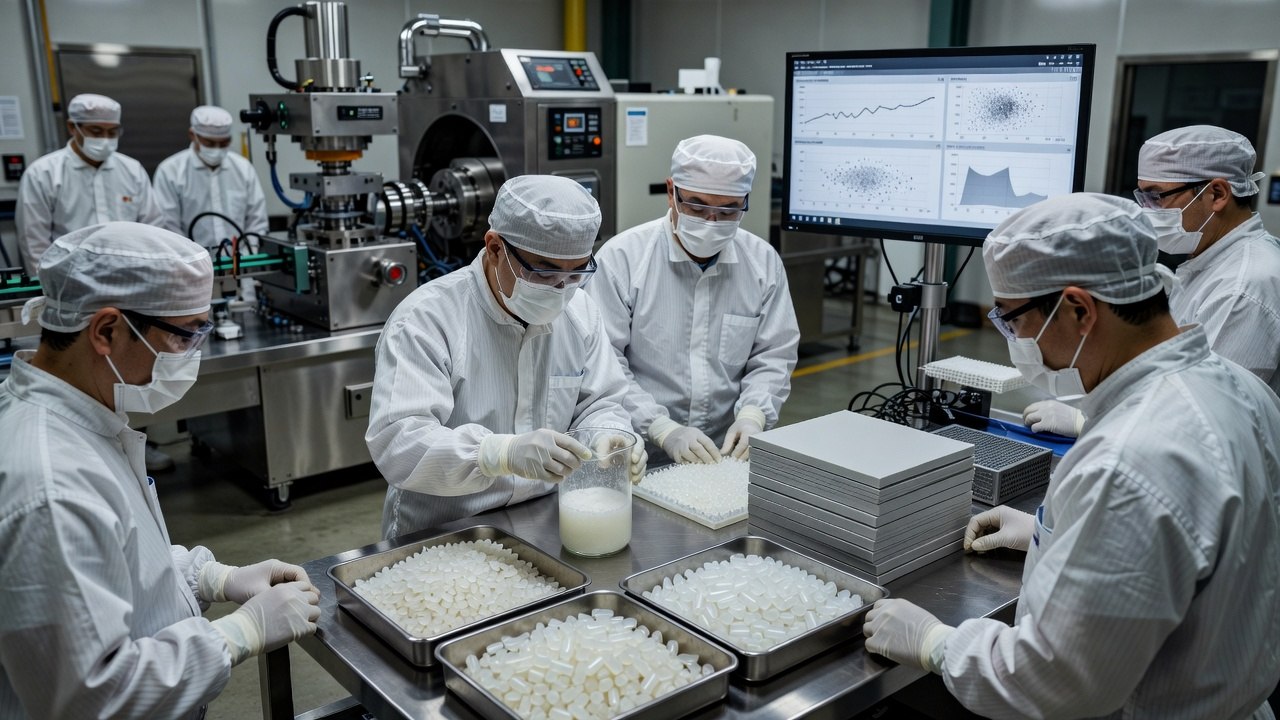
Hankuk Paper presented nanocellulose functional materials and tailored surface-modification technology at Nano Korea 2026, held July 8–10. Public reports describe a direction: improve dispersion in polymers such as PE and PP while targeting heat resistance and flame retardancy. They do not disclose a commercial grade, loading, test method, quantitative performance or approved packaging application. The appropriate next step is therefore a resin-specific pilot validation, not a broad green-material claim.
What the Public Sources Do and Do Not Establish
The July 9 report says Hankuk Paper displayed nanocellulose, cellulose composites, electromagnetic-shielding and heat-dissipation materials, and sustainable packaging solutions. An August 3 follow-up says the company held technical consultations with more than 160 companies and institutions and was discussing joint development and commercialization with 15 promising partners. This establishes market exploration and development work—not commercial packaging qualification.
| Item | Publicly supported | Evidence still needed |
|---|---|---|
| Material | Nanocellulose with tailored surface modification | Size, morphology, surface chemistry, solids, moisture and delivery form |
| Target polymers | Direction for use in polymers including PE and PP | Compatibility by resin grade, loading and compatibilizer package |
| Target properties | Focus on dispersion, heat resistance and flame retardancy | Methods, controls, thickness, numeric results and variation |
| Commercial stage | 160-plus consultations; discussions with 15 partners | Paid supply, customer approval, production lots and end products |
| Packaging use | Packaging identified as an application area | Food contact, sealing, print, drop/compression and recycling evidence |
Nanocellulose is hydrophilic while PE and PP are non-polar. Surface modification can reduce this interfacial mismatch and help prevent fiber agglomeration. Results still depend on the modifier, moisture control, drying history, resin grade and melt-processing temperature.
Seven Validation Axes Before Packaging Use
1. Feedstock and Moisture
Link nanocellulose lot, morphology, surface chemistry, drying route, residual moisture and bulk density to the COA. Excess moisture can produce bubbles, odor, hydrolysis and surface defects during extrusion.
2. Dispersion and Interface
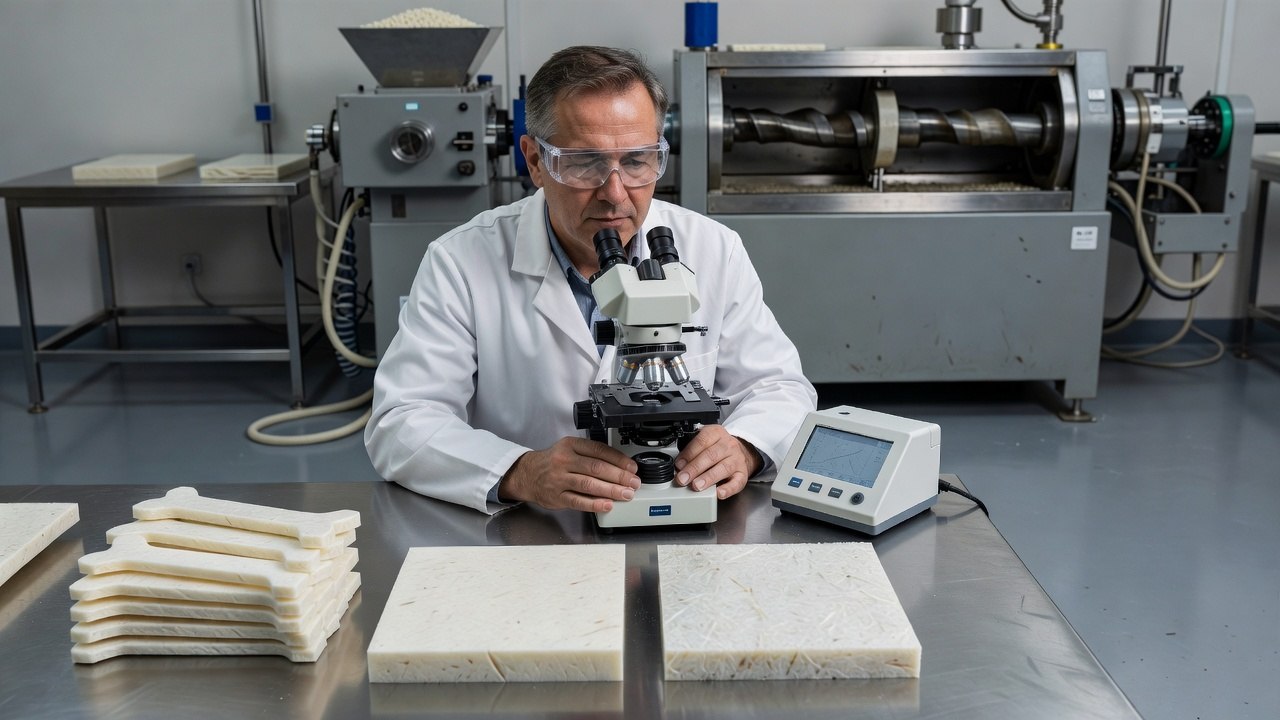
Run PE and PP separately. Record masterbatch concentration, addition sequence, screw design, temperature and shear. Quantify agglomerates and location-to-location variation with cross-section microscopy rather than relying on a visual statement that the material is “well dispersed.”
3. Mechanical Performance
Do not approve on tensile strength alone. Compare tensile properties, modulus, impact, flexure and creep against unfilled resin. In the actual package, add drop, compression, stacking and hinge-fatigue tests. Higher stiffness can arrive with lower impact toughness.
4. Thermal and Flame Performance
Evaluate heat distortion, melt flow, crystallization, oxidative stability and discoloration during processing. Define the applicable flame test, thickness, conditioning and pretreatment before interpreting a flame-retardancy target as a pass or certification.

5. Forming, Sealing and Printing
Track extrusion torque and pressure, screen-pack blockage, die buildup, molding or thermoforming shrinkage, and appearance. Packaging trials also need seal windows, ink and adhesive anchorage, friction, dust and actual line speed.
6. Use-Specific Compliance
Food, cosmetics, automotive and electronics require different evidence. Direct food contact requires a separate review of authorized constituents, overall and specific migration, residuals and conditions of use. Interest from automotive or electronics companies is not food-contact evidence.
7. End of Life and Environmental Basis
Adding a bio-based filler to PE or PP does not automatically improve mono-material recycling. Test sorting recognition, melt-filtration residue, recyclate properties, repeated extrusion and the real collection route. Any plastic-reduction or carbon claim needs a mass balance and life-cycle comparison on equal function and service life.
Copy-Ready Pilot Approval Table
| Gate | Conditions to record | Minimum evidence | Hold condition |
|---|---|---|---|
| Feedstock | Lot, moisture, modification and delivery form | TDS/COA, moisture, size and surface analysis | Modifier or moisture window undefined |
| Compounding | PE/PP grade, loading, masterbatch, heat and shear | Batch record, torque/pressure and dispersion images | Repeat agglomeration, bubbles or screen blockage |
| Performance | Thickness, conditioning, control and method | Mechanical, thermal and flame raw data with variation | Only a qualitative company description exists |
| Converting | Form, seal, print, bond and line speed | Pilot output, defects and downtime | Laboratory plaque only |
| Fitness for use | Contents, contact/use conditions and life | Migration/compliance review and package test | Use-specific safety evidence incomplete |
| Circularity | Route, sorting, reprocessing and functional unit | Recycling pilot, mass balance, LCA and cost | “Bio-based equals green” is the only basis |
Claims That Require a Hold
- Turning discussions with 15 companies into 15 commercial contracts
- Treating PE/PP applicability as proven dispersion in every resin grade
- Converting a focus on heat resistance or flame retardancy into a test pass or certification
- Using automotive or electronics discussions as evidence for food-contact approval
- Claiming better recycling or lower carbon solely because nanocellulose was added
The presentation is a meaningful sign that a paper producer is extending cellulose beyond paper into functional materials. It remains an exhibition, consultation and joint-development story. Packaging adoption should follow only after interface and dispersion, real converting, use-specific compliance and the recovery route are linked under one controlled pilot.
About the Author
PackingMaster: Editor of Paper Pack Log. We collect and organize market trends, product information, and technical insights for the paper packaging industry.