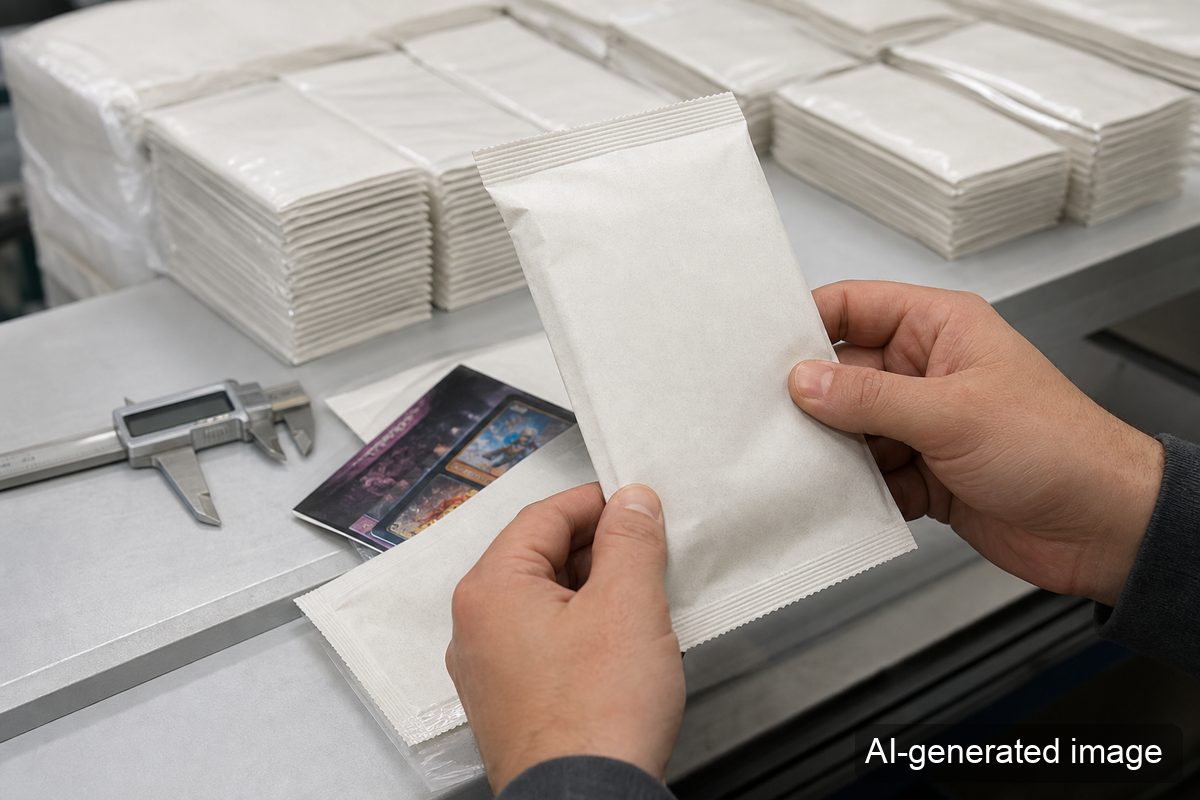
Trading cards, limited-edition goods, small electronic accessories, and other compact premium products place unusual demands on packaging. The contents should not be visible before opening. Consumers should not be able to identify what is inside by looking through the package. At the same time, the pack still needs strong print quality, shelf appeal, and a premium opening experience.
That is why plastic films and metallized structures have traditionally been common in this field. Toppan’s recently reported light-shielding paper-based trading card packaging is a useful signal that paperization is moving into more demanding applications.
According to Packaging Insights, the solution is a paper-based pillow pack designed to achieve 98% light-shielding. The goal is to prevent the cards from being visible through the package and reduce “pack searching,” where consumers try to identify rare cards before opening.
This article is not a product endorsement. It uses the case to ask a practical question: what should packaging teams check when they consider paper packaging for cards and other small high-value products?
Paper packaging now needs opacity
Paper packaging is often discussed in terms of recyclability, natural texture, and plastic reduction. For trading cards and small premium goods, another requirement becomes critical: opacity.
If the contents can be seen through the pack, several problems can follow.
- Consumers may try to identify the product before purchase.
- Randomized products may appear less fair.
- Color or shape differences may create customer complaints.
- A premium product may look poorly protected.
In this field, paperization is not simply a material swap. The package must also handle light blocking, print appearance, seal strength, opening feel, and shelf handling.
What card packaging can teach industrial packaging
Trading cards are a consumer application, but the lesson is relevant for industrial packaging as well. Small products may use less material, but high-value products can suffer major brand damage if the package feels weak or reveals too much information.
The same logic can apply to electronic components, precision parts, sample kits, serialized spare parts, and small service items.
Paper-based opaque packaging may be worth reviewing when a product has one or more of the following conditions.
The contents should not be visible
Randomized items, security-sensitive products, serial information, or color variants may need stronger concealment.Plastic reduction is a customer requirement
Retail, trade-show, e-commerce, and export customers may ask for lower plastic use.The product is small but high value
A slightly higher packaging cost may be acceptable if it protects brand value and reduces tampering concerns.The company wants a paper recycling route
This still needs verification. Coatings, inks, adhesives, and barrier layers can affect recyclability claims.
The word “paper” is not enough
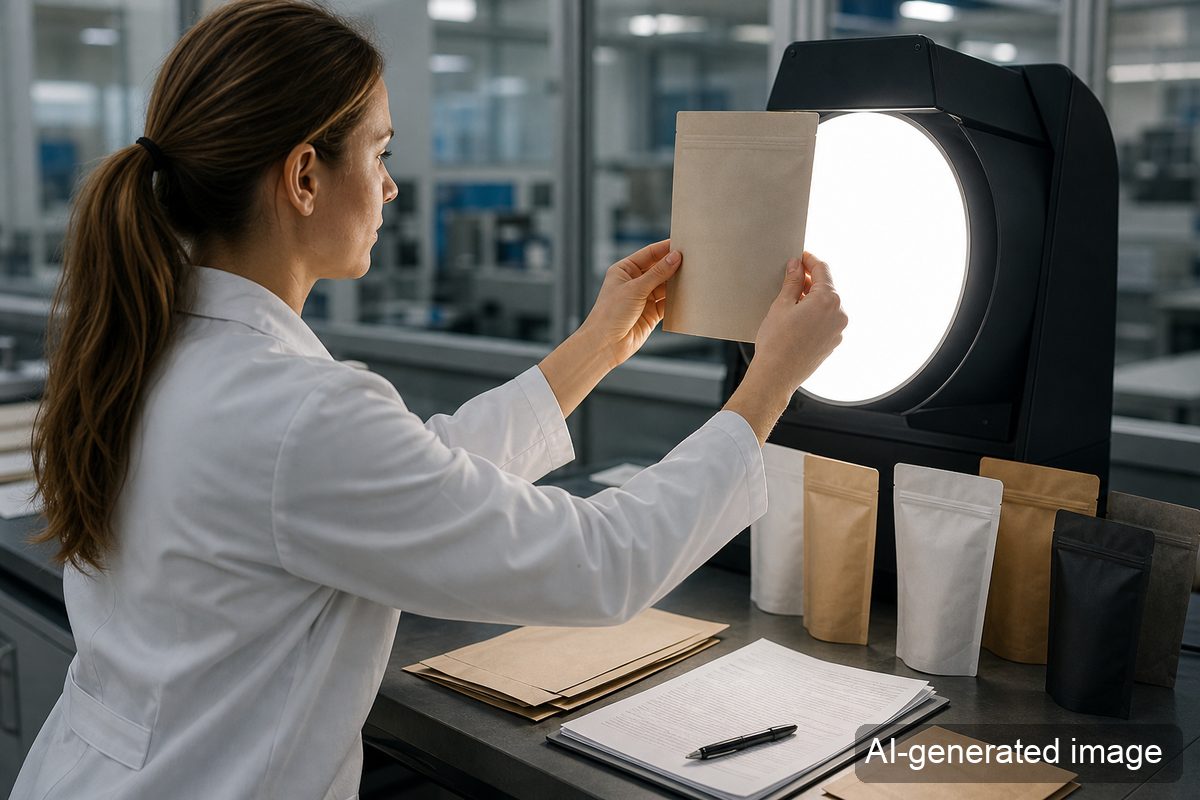
A light-shielding paper package should not be assumed recyclable simply because it is paper-based. Opacity and print quality may require coatings, metallized effects, laminations, or specialty inks.
When reviewing a proposed material, packaging teams should ask these questions first.
- Under what test conditions was the light-shielding rate measured?
- What is the paper share versus non-paper components?
- Do sealing areas and tear notches affect paper recycling?
- Do coatings, metallic effects, or inks interfere with sorting or recycling?
- Can the material run on the existing packaging line?
- Does performance hold under humidity, friction, display lighting, and storage?
The key issue is not the phrase “eco-friendly packaging.” The useful question is whether the packaging can be explained with data: light-shielding performance, material composition, unit weight, recyclability conditions, and line trial results.
Line compatibility should be tested early
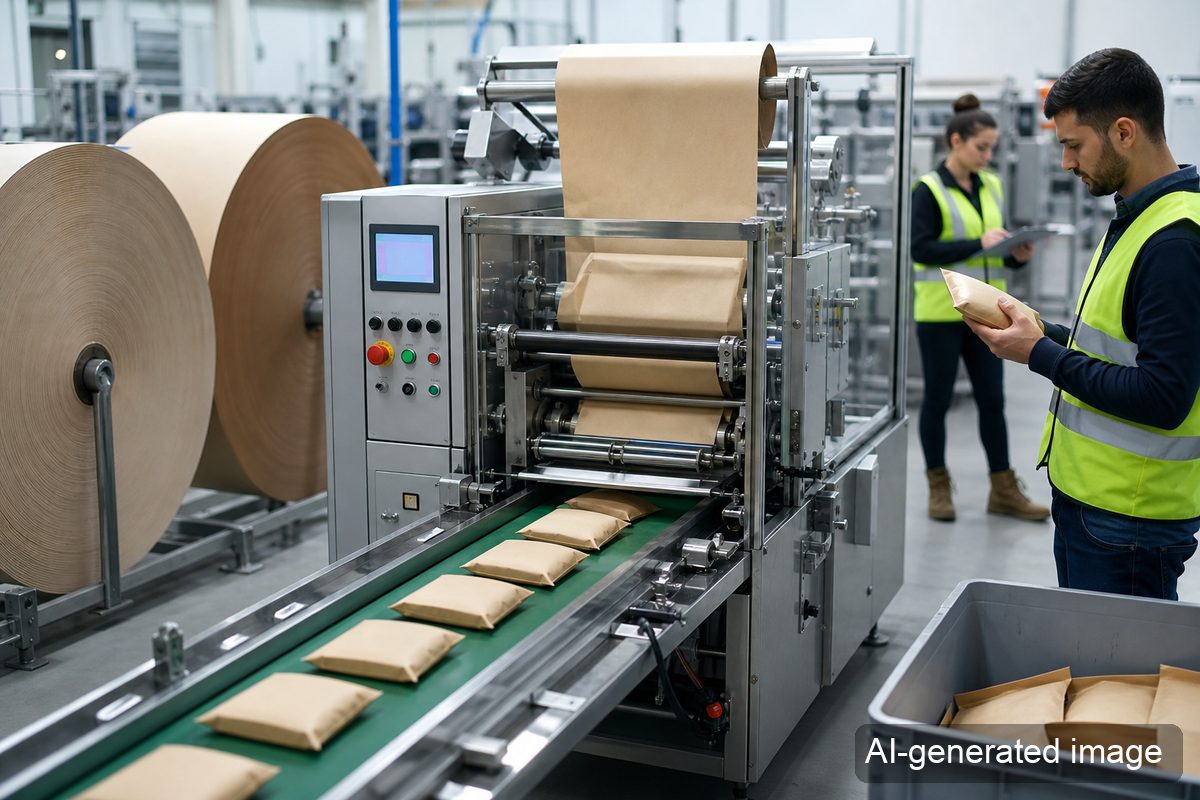
Small pouch packaging often fails at the equipment stage, not at the material brochure stage. A line designed for plastic film may react differently when a paper-based substrate is introduced. Feeding tension, folding, tearing, heat sealing, static, and print-surface scratching can all change.
Early trials should check at least the following points.
- Width and thickness range accepted by the existing pillow packer or flow wrapper
- Whether heat sealing, cold sealing, or adhesive methods need to change
- Corner folding and edge fiber issues
- Jamming in counting and feeding devices
- Required speed reduction, if any
- Impact on secondary cartons, displays, and e-commerce packaging
Paperization is a material change, but in production it is also an equipment question. Teams should record actual defect types during a short pilot run rather than making the decision from samples alone.
Closing thoughts
Toppan’s light-shielding paper packaging case suggests that paper is moving beyond simple plastic replacement and into applications that require security, opacity, and premium presentation. But the phrase “paper-based” is not enough.
Companies considering paper packaging for cards, collectibles, precision parts, or small sample products should review light-shielding performance, material composition, recyclability claims, seal strength, and equipment compatibility together. The next stage of paperization will not be defined by whether a pack uses paper. It will be defined by how well paper can replace the functions that plastic packaging used to provide.
About the Author
PackingMaster: Editor of Paper Pack Log. We summarize market trends, product information, and technical insights from the paper packaging industry.
References
- Packaging Insights, “Toppan replaces plastic with paper-based trading card packaging”, https://www.packaginginsights.com/news/toppan-light-shielding-paper-trading-cards.html
- Background — European Commission, Packaging waste, https://environment.ec.europa.eu/topics/waste-and-recycling/packaging-waste_en