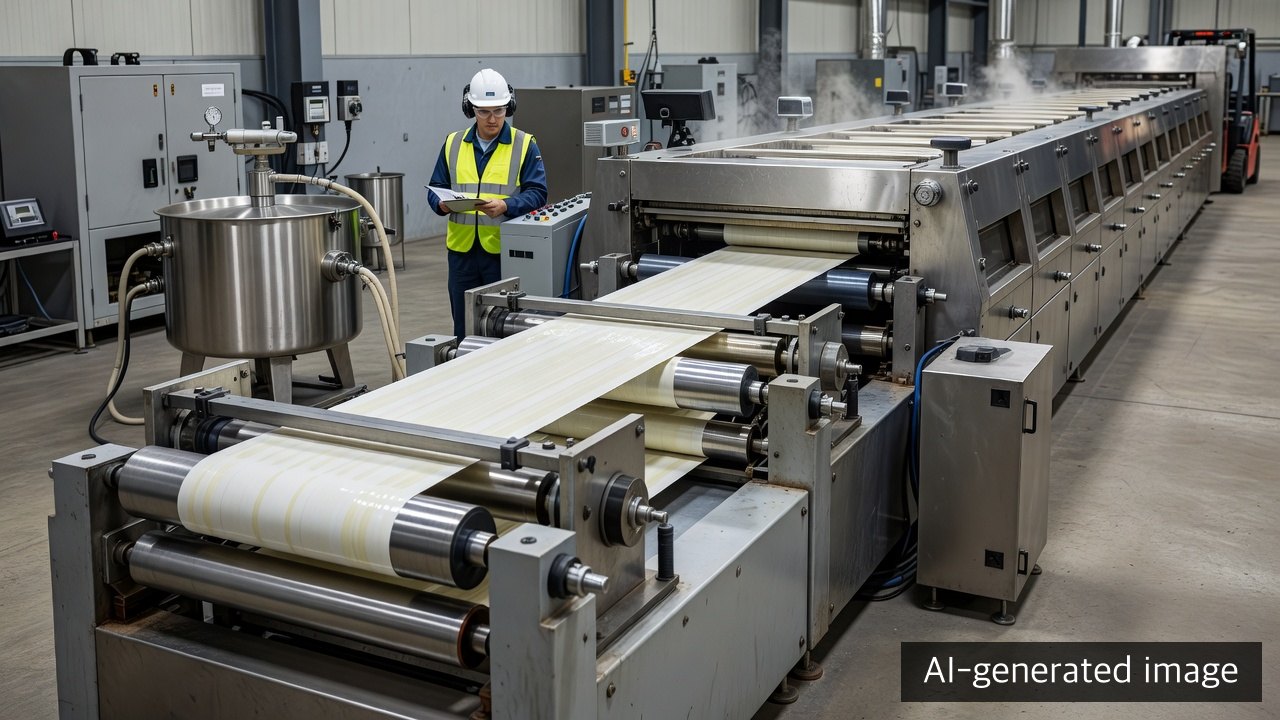
A higher solids content in a water-based pressure-sensitive adhesive (PSA) may reduce the water that must be evaporated to make the same dry adhesive coat. Supplier terms such as ultra high solids, energy savings and standard performance, however, do not prove that a product can be dropped into an existing label coater. Development, production and quality teams should compare liquid handling, coat uniformity, drying load, peel, tack, shear, ageing, real substrates and recycling compatibility in one controlled pilot.
Product status — checked September 4, 2026: Archroma Packaging Technologies announced on August 27 that it plans to introduce
Cartacol® APS75 Ultrato the North American market at LOUPE Americas 2026 on September 15–17. The company says the patent application is pending and invites converters to trial the product ahead of its commercial launch. Its release describes conventional water-based PSAs as having approximately 65–70% solids and says the new platformsignificantly increasessolids, but it gives no exact new-product solids, viscosity, coat weight, drying speed or peel, tack and shear data. The75in the product name must not be interpreted as verified 75% solids.
Separate the Announcement from the Required Evidence
| Item | Public-source wording | Plant decision status |
|---|---|---|
| Product stage | Planned event introduction, patent pending and trial invitation ahead of commercial launch | Pre-production approval |
| Intended segment | Company says it is designed for general permanent paper labels | Confirm by actual face, surface and temperature |
| Solids | Company describes conventional water-based PSA at about 65–70% and says the product increases that level significantly | Exact product value and method are undisclosed; require CoA, TDS and verification |
| Processability | Company says the platform remains fully processable at industrial scale | Verify pumping, filtration, foam, levelling and coater stability |
| Drying and energy | Company says less water supports lower energy use | Measure against a control at equal dry coat and quality |
| Adhesion | Company says it was formulated to match standard PSA performance | Raw peel, tack, shear and ageing data are not public |
| Market share | Company describes general permanent paper labels as roughly 90% of the market | Treat as a company estimate, not independent market evidence |
Packaging Europe’s report attributes the performance descriptions to the company and does not provide an independent performance test. This article therefore does not certify the product. It defines the evidence needed to turn a supplier announcement into plant data.
Why Higher Solids Does Not Automatically Prove an Energy Saving
At the same target dry coat weight, liquid input and water evaporation depend on solids. Actual electricity or gas use also depends on viscosity, pumping and filtration pressure, coating-head stability, web speed, dryer-zone temperature and airflow, exhaust, residual moisture, cooling, winding and rejects.
Keep two measures separate in the pilot:
- Theoretical water load: liquid coat and water-to-evaporate calculated from supplier CoA or measured solids and the target dry coat weight
- Measured line load: web speed, dryer settings, exhaust, metered energy, residual moisture and good yield under the same acceptance criteria
A lower water input may not improve energy per good square metre if higher viscosity forces a speed reduction or increases coating and levelling defects. A plant benefit requires maintained quality and throughput together with a lower measured drying burden.

Copy-Ready Material-to-Equipment Pilot Matrix
A. Liquid, Coating and Drying Conditions
| Input or observation | Control PSA | Candidate PSA | Status and next action |
|---|---|---|---|
| Product and batch | [product / lot / manufacture date] | [product / lot / manufacture date] | Hold testing if the lot is not traceable |
| Solids | [method / measured value / CoA] | [method / measured value / CoA] | Do not infer from the product name; verify by the same method |
| Viscosity, temperature and shear condition | [instrument / spindle or rate / temperature] | [same conditions] | Do not compare values from different conditions |
| Storage, mixing and deaeration | [time / method / foam] | [time / method / foam] | Stop and investigate gel, sediment or persistent foam |
| Pumping and filtration | [pressure / filter / blockage] | [pressure / filter / blockage] | Stop the line trial on abnormal pressure or filter loading |
| Target dry coat weight | [g/m² / tolerance] | [same target] | Separate energy and performance comparisons if targets differ |
| Coating condition | [streak / pinhole / edge / profile] | [same observations] | Address rheology and head window before raising speed |
| Drying and speed | [zone setting / web speed / exhaust] | [same format] | Record metered energy and good output, not settings alone |
| Dried-web condition | [residual moisture / blocking / winding] | [same tests] | Hold production approval on residual, blocking or telescoping defects |
| Energy per good output | [meter boundary / energy / good area] | [same boundary] | Do not calculate savings from different boundaries or output bases |
B. Adhesion, Durability and Recovery Conditions
| Test group | Conditions to lock | Result to record | Acceptance evidence or hold condition |
|---|---|---|---|
| Peel adhesion | Selected edition of FINAT FTM 1 or FTM 2, face, adherend, dwell and environment | Individual values, average and failure mode | Compare with customer requirement or approved control; no invented limit |
| Loop tack | Selected edition of FINAT FTM 9, surface and temperature | Initial adhesion and failure mode | Add actual-use trials for curves, cold or contaminated surfaces |
| Shear | Selected edition of FINAT FTM 8 or FTM 18, load, area and temperature | Hold time, slip and cohesive or interfacial failure | Do not rank values produced by different methods as equivalent |
| Coat weight | Selected edition of FINAT FTM 12 and cross-web locations | Dry coat weight and profile | Link each adhesion result to the same specimen location |
| Ageing | FINAT FTM 5 plus product-specific time, temperature, humidity and light | Change in peel, tack, shear, yellowing and bleed | Initial pass alone does not establish shelf life |
| Low temperature | FINAT FTM 13 plus actual application and service temperature | Wet-out, lift and failure mode | Do not extend room-temperature results to chilled or frozen use |
| Recycling compatibility | FINAT FTM 19 or the applicable customer/recycling route on the finished label | Fibre release, separation, residue and sticky impact | Evaluate the face, print, adhesive and liner structure, not adhesive alone |
FINAT says the 11th edition of its Technical Handbook is current and contains 31 test methods. Its public list separates peel, shear, loop tack, coat weight, ageing, low-temperature adhesion and recycling compatibility of self-adhesive labels. A test method does not itself supply a product limit, so the actual edition and customer acceptance basis belong in the pilot record.

Pilot Sequence
G0. Lock Commercial and Document Status
Request the TDS, SDS, CoA, regulatory or food-contact documents where relevant, patent and commercial status, and supply timing. Do not treat an event introduction as commercial availability.
G1. Screen Liquid Risks in the Laboratory
Measure solids and viscosity at the same temperature and method, then compare storage, mixing, deaeration, substrate wetting and dried-film condition. Do not infer an undisclosed composition or exact value from a product name.
G2. Find the Coating Window on a Short Web
Do not move from one successful setting directly to maximum speed. Vary coat weight, speed, temperature, viscosity and dryer zone within a planned matrix and record the boundary at which streaks, pinholes, edge defects or blocking begin.
G3. Compare Energy at Equal Good-Product Criteria
Align target dry coat, web width, quality requirement and meter boundary for the control and candidate. State whether preparation, wash-up, rejects and restart energy are included. Keep supplier calculations separate from plant measurements.
G4. Test Adhesion on Real Adherends
Do not stop at one standard panel. Separate glass, plastic, coated paper, corrugated, curved and low-surface-energy applications where relevant. Record application and service temperatures, contamination, dwell and removability requirements.
G5. Judge Ageing, Converting and Recycling as a Finished Label
Use the actual construction—face, primer, print or varnish, adhesive and liner—for die-cutting, matrix stripping, dispensing, storage and the intended recovery route.
Conditions That Require an Immediate Approval Hold
- Recording 75% solids from the product name without a verified test
- Turning the supplier’s energy-saving statement into a measured plant saving
- Comparing different target dry coats, good-product criteria or meter boundaries
- Comparing viscosity values taken at different temperatures, shear conditions or instruments
- Testing peel but omitting tack, shear, ageing, low temperature and the actual adherend
- Describing a patent-pending, pre-launch event product as commercially available
- Approving recycling compatibility from the words
paper labelor from adhesive-only testing - Missing TDS, SDS, CoA, batch traceability or supplier change-control terms
The value of an ultra-high-solids water-based PSA is not one solids number. It is the simultaneous comparison of water load, line conditions, energy per good output and long-term adhesion. The current public record is a promising supplier announcement, not independent production evidence. A converter can use the pre-launch trial opportunity, but it should fill this matrix with measured data rather than transferring promotional wording into a performance guarantee.
About the Author
PackingMaster: Editor of Paper Pack Log. We collect and organize market trends, product information, and technical insights for the paper packaging industry.
References
- Archroma Packaging Technologies, announcement of Cartacol APS75 Ultra (August 27, 2026)
- Background: Packaging Europe, report on the planned ultra-high-solids PSA introduction (August 28, 2026; repeats supplier-attributed claims)
- FINAT, public list of FINAT Test Methods and the 11th-edition Technical Handbook