
May 31, 2026 was the day US packaging EPR moved from “paperwork phase” to “data deadline phase.” This post is a retrospective of the first reporting and registration deadlines that followed California SB 54’s final regulations, and a checklist for what Korean export packaging suppliers should put in place before the next deadlines: source reduction baseline (around July 1), source reduction plan (around August 1), and CY2026 annual reporting.
This post does not aim to be a general primer on California SB 54 or state-by-state US EPR. That introduction is already covered in “US Packaging EPR Expansion: What California and Oregon Mean for Korean Export Packaging”. The focus here is what to fix in the next 30–60 days, now that the first cutoff is past.
What Was Due on May 31 – June 1
CalRecycle approved and filed the SB 54 (Plastic Pollution Prevention and Packaging Producer Responsibility Act) permanent regulations on May 1, 2026, with immediate effect. The first wave of deadlines under those regulations is structured as follows.
- May 31, 2026: First reporting deadline for producers participating in the PRO. Producers using CAA (Circular Action Alliance, the approved PRO) had to submit their CY2025 annual supply reports and source reduction reports through CAA. These reports inform early program fees and source reduction tracking.
- June 1, 2026: Registration deadline for all covered producers. Each producer must choose one of three paths — register through CAA as a PRO member, register directly with CalRecycle as an independent producer, or register for a small producer exemption if eligible.
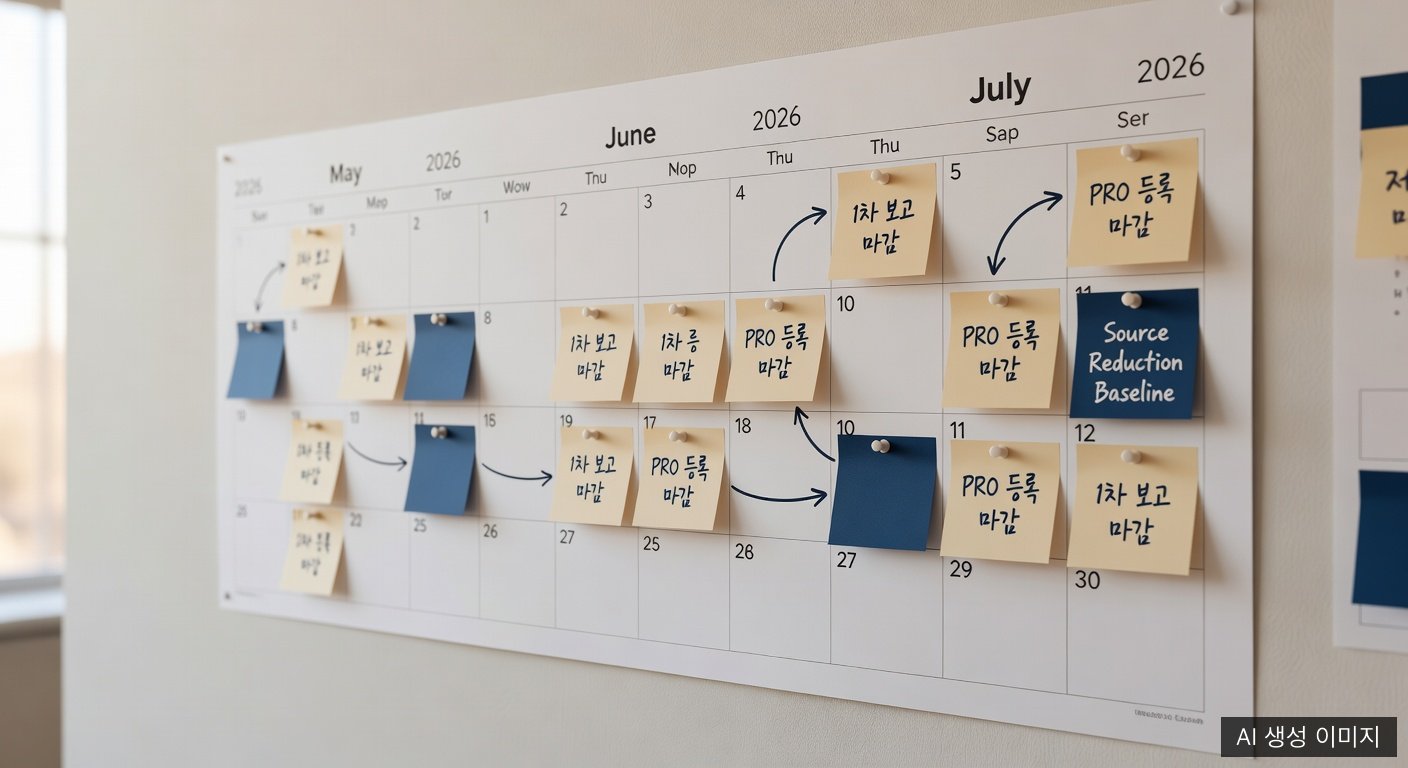
Subsequent milestones include source reduction baseline filings (around July 1, 2026), individual source reduction plans (around August 1, 2026), and CY2026 annual reporting that will begin a new cycle. In short, May 31 and June 1 were a first cutoff, not the finish line.
Gaps Often Missed by Korean Suppliers in the First Round
After the first wave, these are the gaps most often seen at Korean head offices, US subsidiaries, and importing distributors.
1. Assuming “we are not a producer”
SB 54 defines “producer” broadly, including brand owners, importers, and importing subsidiaries that put covered packaging into the California market. If a Korean head office ships its own branded products into California through a US subsidiary or an importer, the head office should not assume it is exempt. “We just do OEM” is not by itself a sufficient reason to skip the analysis.
2. Missing 2023 baseline data
SB 54 uses 2023 as the baseline year for source reduction targets and fee setting. If the Korean head office does not have its 2023 California-bound packaging records on hand, the next deadlines require a backtracking exercise: pull invoices, packing lists, shipping records, and SKU specs for 2023 California shipments, working with US subsidiaries and importing distributors.
3. SKU-level packaging data
Producers must report by covered material category. Corrugated boxes, paper trays, paper labels, plastic wrap, paper/plastic composites, ink layers — each SKU should map to one or more categories. A high-level “boxes — X tons” is not enough to file.
4. Weak basis for recyclability and composite judgments
SB 54, CalRecycle’s guidance, and CAA’s proposed responsible end market standard do not accept the word “recyclable” by itself. Producers should keep test reports, evaluations against frameworks like 4evergreen / CEPI, and documentation of coatings, adhesives, and barrier layers. For paper/plastic composite packaging, separation and recyclability evidence should be filed separately.
5. Skipping the PRO vs. independent decision
Some producers simply missed that there was a June 1 registration deadline at all. Skipping registration can effectively block California-bound shipments, and some US distributors have already started flagging suppliers with no EPR registration number as on hold for new business.
Four Items to Build Before the Next Deadlines

1. Standardize an “EPR-Ready SKU Mapping Sheet”
Build a living mapping sheet that links your quote items, shipping items, and ERP item codes to SB 54 covered material categories (1:1 or 1:N). The minimum fields:
- Internal SKU code
- Packaging type (box, tray, wrap, label, pouch, etc.)
- Primary material + secondary material (coatings, adhesives, ink layers, liners)
- Unit weight (g) — include labels, tapes, and inserts, not only the empty box
- Recyclability classification (recyclable / not recyclable / compostable / mixed)
- US shipping channel (direct export / US subsidiary / distributor)
Treat this as a living document that is updated whenever a new SKU is launched or a packaging spec changes.
2. Run the 2023 Baseline Backtracking on a Separate Track
California baselines use 2023 shipping data. Build a standard request template for the head office to send to US subsidiaries and distributors, and run it on a separate track from regular sales operations. Items to request:
- Copies of 2023 California-bound invoices
- 2023 packaging SKU spec sheets and unit weights
- 2023 mid-year SKU or material changes (where specs shifted mid-year)
- Whether the entity was already registered with any PRO in 2023 (and if so, copies of those reports)
3. Prepare EPR Response Scripts for the Sales Team
US buyers and distributors increasingly ask for “your SB 54 producer registration number” or “your data in the CAA reporting format.” Sales teams should have three pre-built response scripts ready:
- Already registered: registration number, PRO vs. independent designation, applicable categories
- Registration in progress: current stage, expected completion date, what interim data the company can share
- Not in scope: reasoning (revenue threshold, market entry path, brand owner definition, etc.)
A single “we are reviewing it” answer erodes trust. Prepared, stage-specific scripts hold up.
4. Manage a Multi-State CAA Calendar
CAA is the PRO for California, Oregon, Colorado, and other states. Because deadlines tend to cluster, it makes sense to manage a single CAA calendar internally. Track separately:
- California SB 54: reporting / registration / baseline / plan deadlines
- Oregon RMA (Recycling Modernization Act): PRO reporting deadlines
- Colorado PEPR (Producer Responsibility Program for Statewide Recycling): reporting deadlines
- Newer states like Maine and Minnesota: progress status
Three Quick Wins for Sales and Procurement This Week
- Segment US-bound SKUs: This week (first week of June), separate California-bound SKUs from the broader US-bound list and tag them internally (for example, “CA-EPR”).
- Touch base with US distributors: Send a short note to first-tier US distributors saying you are confirming SB 54 registration status. That cuts response time when EPR data requests arrive in H2 2026 quotes.
- Add calendar reminders for the next deadlines: Add reminders for July 1 source reduction baseline, August 1 source reduction plan, and the CY2026 reporting cycle — and write the owner, the required data, and the internal cutoff date in one line, not just the deadline.
Conclusion
CalRecycle’s May 1 final regulations and the May 31 – June 1 cutoff together mark the moment when US packaging EPR moved from “wait and watch” to “data obligations.” The next deadlines start within 30–60 days. For Korean export packaging suppliers, the work that matters most is not clearing one deadline but building the data infrastructure — SKU mapping, 2023 baseline backtracking, sales scripts, multi-state calendar — that lets you clear the deadlines that follow.
For a broader view of the state-by-state US picture, see “US Packaging EPR Expansion: What California and Oregon Mean for Korean Export Packaging”.
About the Author
Lee Daeri, Marketing Team, Yunsung Co., Ltd. Covers paper packaging export marketing and translates overseas packaging regulations into sales-floor language.
References
- Background — CalRecycle, Packaging EPR — https://calrecycle.ca.gov/packaging/packaging-epr/
- Background — CalRecycle, Producer Guidance — https://calrecycle.ca.gov/packaging/packaging-epr/producerguidance/
- Holland & Knight, “California’s Final EPR Regulations Now in Effect” (May 2026) — https://www.hklaw.com/en/insights/publications/2026/05/californias-final-epr-regulations-now-in-effect
- Venable, “California Finalizes Long-Awaited EPR Regulations” (May 2026) — https://www.venable.com/insights/publications/2026/05/california-finalizes-long-awaited-epr-regulations
- Buchalter, “California’s SB 54 Packaging Law — Don’t Miss the May 31 and June 1, 2026 Reporting Deadlines” — https://www.buchalter.com/blogs/californias-sb-54-packaging-law-dont-miss-the-may-31-and-june-1-2026-reporting-deadlines-action-steps-for-california-businesses-to-stay-compliant/