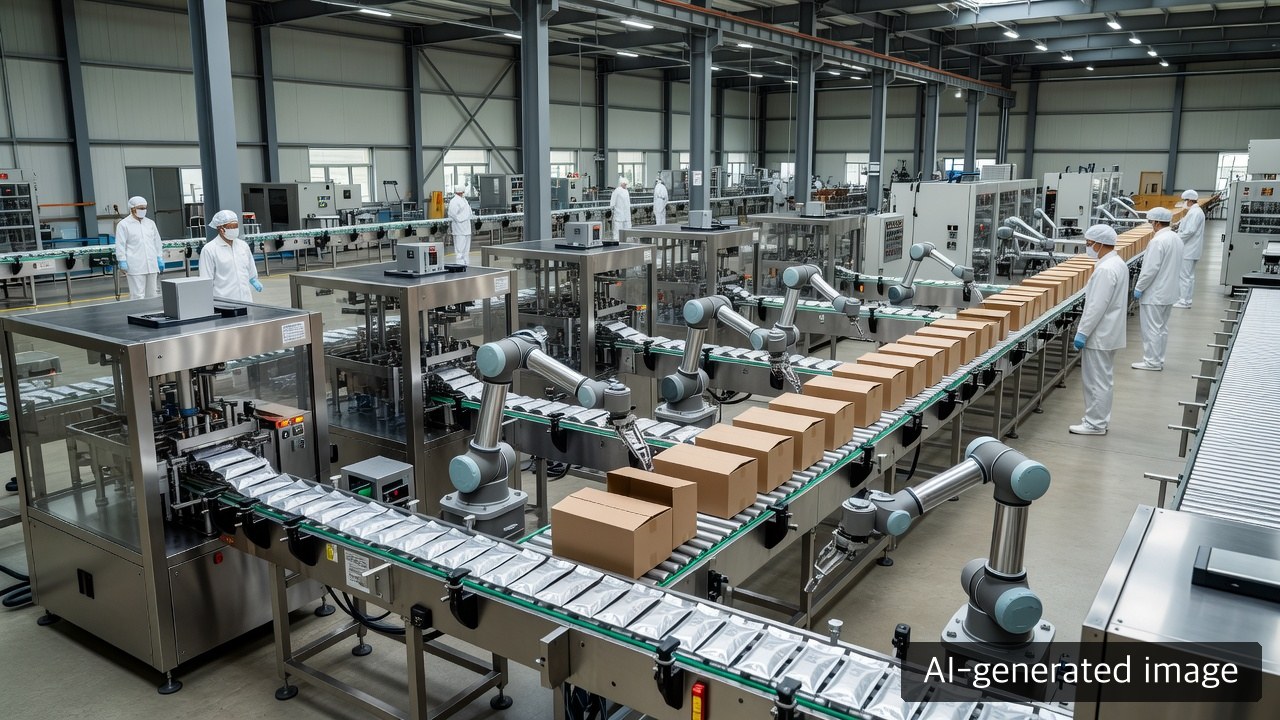
A peak-season packaging line can stop for film or carton replenishment, a changeover, quality holds, case-packing queues or warehouse congestion even while the filler is running fast. Production, quality, materials and logistics teams therefore need to see not only the daily total but which process is likely to become the next constraint. This article does not copy one plant’s practice as a universal standard; it converts the public Wonju case into a four-hour packaging-line control board that a site can populate with its own data.
Evidence boundary — checked 10 September 2026: Aju Business Daily reported on 1 September that the Wonju plant’s total production plan for the 2026 Chuseok season was 18.3% above normal, while selected stick and pouch product families were up 49.3%. The report said the stick filler operated for 22 hours per day excluding cleaning and inspection, with some processes alternating between two and three shifts according to volume. These figures and equipment descriptions are case values reported from an on-site visit and company representatives, not an independently verified performance test.
Separate public facts from operating interpretation
On mobile, swipe the table horizontally to view the hidden columns.
| Area | Confirmed in public sources | Operating interpretation in this guide | Do not assume |
|---|---|---|---|
| Peak volume | A higher 2026 Chuseok production plan was reported | Manage product mix, material consumption and queues by time window, not average rate alone | The same percentage applies to every product and every day |
| Operating hours | The stick filler was reported to run 22 hours excluding cleaning and inspection | Reserve planned downtime before calculating usable production time | Longer hours automatically improve delivery or quality |
| Inspection and packing | Vision inspection, weight checking, sterilisation and robotic case packing were described | Record rejects and case-packing queues separately from filler output | Machine nameplate speed equals shipped good output |
| Warehouse handoff | Finished cases were reported to move by conveyor into an automated warehouse | Track warehouse induction, put-away and releasable stock separately from case closure | Closing a case means customer dispatch is complete |
KGC’s maintained Wonju factory page describes portable pouch production, an end-to-end system from raw-material receipt to shipment, a quality-assurance framework and an automated finished-goods warehouse. Neither that page nor the site report discloses product-level OEE, time lost to packaging-material shortages, vision-system false-reject rates or maximum warehouse induction capacity. The board below therefore leaves those values as site inputs, rather than estimating them.
Four hours is a management window, not a published result
The four-hour interval is not an official Wonju standard or an industry requirement. A daily plan can hide a small morning delay that becomes a large night-shift shortfall, while continuous half-hour rescheduling can destabilise changeovers and material staging. As a practical example, this guide fixes the next four hours so a team can make at least two forward-looking decisions within one shift. A site may replace it with two hours or a full shift.
Before each window begins, connect six inputs to the same production-order identity:
- Product, lot and planned quantity: include sequence and expected changeover time, not only a total.
- Planned stops: separate cleaning, inspection and film, tooling or declaration changes from production time.
- Packaging-material coverage: state which production orders can be completed with available film, cartons, inserts, labels and consumables.
- Quality state: record first-off approval, leak, appearance and weight rejects, held quantity and release authority.
- Downstream capacity: check robotic case packing, sealing, palletising, warehouse induction and outbound staging.
- Shift and recovery: name the next owner, open abnormal conditions, fallback route and restart conditions.
Packaging-line flow board
On mobile, swipe the table horizontally to view the hidden columns.
| Stage | Required record | Red signal | Owner and immediate action |
|---|---|---|---|
| Filling and forming | Product, actual good rate, changeover and cleaning finish time | Delay consumes the next planned changeover slot | Production: reset the next start time and notify planning of affected orders |
| Inspection and hold | Defect type, rejected quantity, hold time and release authority | Rejects rise while reason codes remain consolidated | Quality: preserve samples and settings, then segregate held lots by cause |
| Robotic case packing and sealing | Pouches in, cases out, pouch queue and carton change | Filler remains normal while unpacked work-in-process rises | Packaging: separate carton supply, robot pick and sealing or discharge causes, then assess safe manual fallback |
| Material replenishment | Next delivery time and usable orders for film, cartons and labels | Material will run out before the next approved delivery | Materials: confirm an approved substitute lot or jointly approve resequencing with production and quality |
| Warehouse handoff | Induction, put-away, releasable state and waiting pallets | Finished cases accumulate at the line end or in aisles | Logistics: separate induction, location and carrier cut-off causes, then set a temporary-buffer limit |
Track arrival time, not just packaging inventory
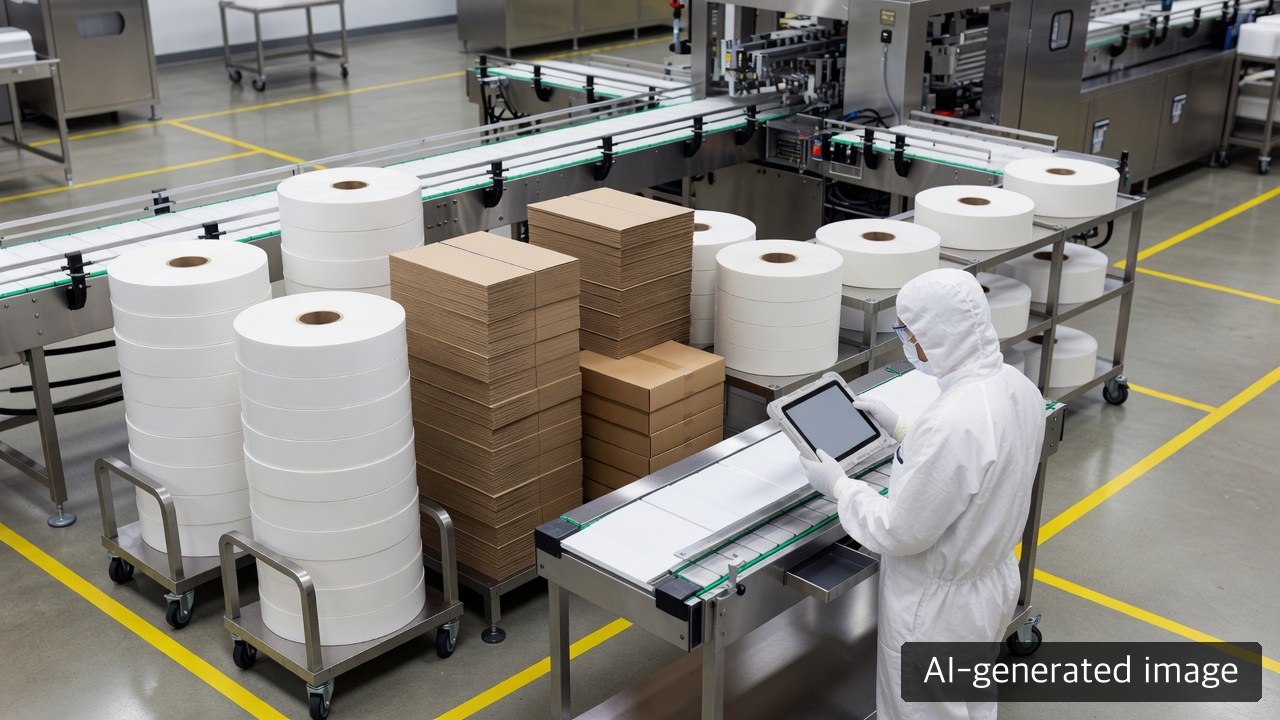
Saying that packaging inventory is sufficient does not protect a peak operation. What matters is when the correct specification, print version and approved lot reaches the line for the next production order. Materials that look interchangeable may still have different declarations, dimensions or lot approvals.
For every four-hour window, the materials owner should answer:
- Have film, cartons and labels for the next product cleared quality checks?
- Will the current quantity at the actual consumption rate last until the next delivery?
- Does replenishment conflict with people, robots, forklifts or waste-removal routes?
- Does a substitute lot have production, quality and declaration approval?
- Can the packaging-material lot be traced back from the finished-goods lot?
When a shortage is predicted, increasing speed only consumes the remaining stock faster. Decide first whether to resequence orders, use an approved substitute lot or change the delivery time.
Do not merge quality rejects and case-packing queues into one “stop”
A vision system may reject units while the line continues, reducing good output without a machine stop. In another case, inspected pouches may queue before the robot while the filler remains healthy. Combining both situations under “line efficiency loss” removes the accountable owner.
- Inspection rejects rising: quality links samples, defect type, timestamp and equipment condition to narrow the cause.
- Work-in-process before case packing rising: packaging separates carton supply, robot pick, sealing and discharge conveyor conditions.
- Finished goods rising before the warehouse: logistics separates induction, location assignment, system release and carrier cut-off.
- Several queues rising together: planning reduces upstream release and updates affected orders and recovery time.
Bypassing inspection or mixing held units with released product to protect the total is not a recovery plan. If release authority and segregation location are unclear, the lot remains on hold.
Finish shift handover in four complete statements
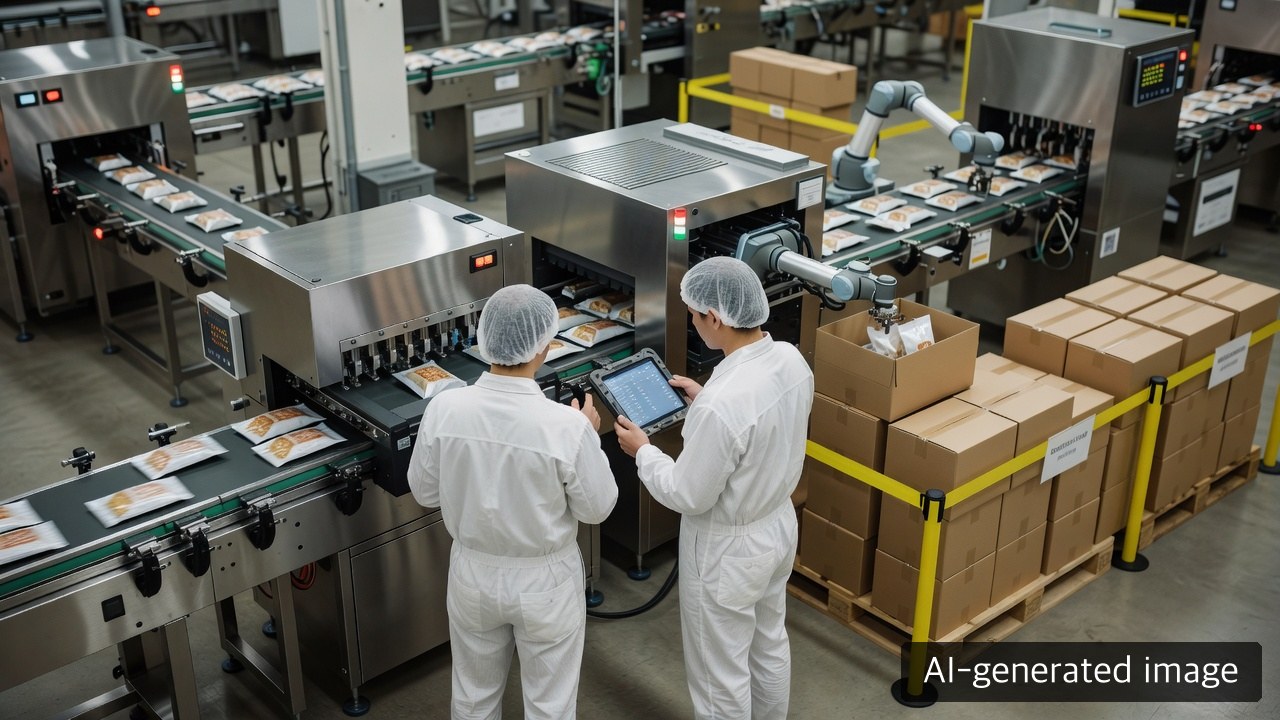
During peak operations, the next shift needs actionable sentences rather than a long narrative. Record these four lines by production order:
Current order/progress:[product, lot, good quantity, remaining quantity]Current constraint:[material/changeover/equipment/inspection/case packing/warehouse] — [time and evidence]Next action:[owner] will [verb + target] at [time or trigger]Stop/restart condition:[condition that stops release] / [person and evidence required to restart]
“Being checked”, “no issue” and “handed to the next shift” are incomplete. Replace “carton shortage under review” with a controlled sentence such as: “If Materials cannot confirm arrival of approved carton lot A by 10:00, hold the next product start and require Planning to reapprove the sequence.”
Pass and hold criteria for the peak board
Pass
- Product sequence, planned stops and packaging-material arrival times are connected for the next four hours.
- Inspection rejects, pre-case-packing work-in-process and warehouse queues use different cause codes.
- Every red signal has an owner and immediate action.
- The next shift can follow the same production order, packaging-material lot and quality state.
Hold
- Only equipment nameplate rate exists; actual good output, waiting and rework are missing.
- Only total inventory exists; arrival time of the correct specification and approved lot is unknown.
- No authorised person or segregation location is defined for held product.
- Finished cases are accumulating, but no one knows whether induction, put-away or dispatch is constrained.
- Shift handover lacks an owner, action or restart condition.
Conclusion
The visible features of the Wonju case are long operating hours and extensive automation. The transferable lesson is not a particular speed or volume. It is an operating method that reveals the next constraint when filling, inspection, case packing, materials and warehousing move at different rates.
Place one four-hour board beside the daily production total and populate the first window with the real product sequence, planned stops, material arrival times, held units, warehouse queue and shift owner. The public case starts the question; release decisions must come from the site’s own data and approval process.
About the Author
PackingMaster: Editor of Paper Pack Log. We collect and organize market trends, product information, and technical insights for the paper packaging industry.
References
- Aju Business Daily, “Chuseok Approaches and the Red-Ginseng Line Runs at Full Load: Wonju Plant Produces Up to 1.3 Million Packs a Day” (1 September 2026, Korean)
- KGC, “Wonju Factory” (Korean)
Sources checked on 10 September 2026. Production-plan increases, operating hours and equipment flow are limited to the Aju Business Daily site report and statements attributed to company representatives. The maintained factory page is KGC’s description of products, its receipt-to-shipment system, quality assurance and automated warehouse. The four-hour board and pass/hold criteria are an editorial operating guide reconstructed from packaging-line dependencies, not an estimate of undisclosed plant performance.