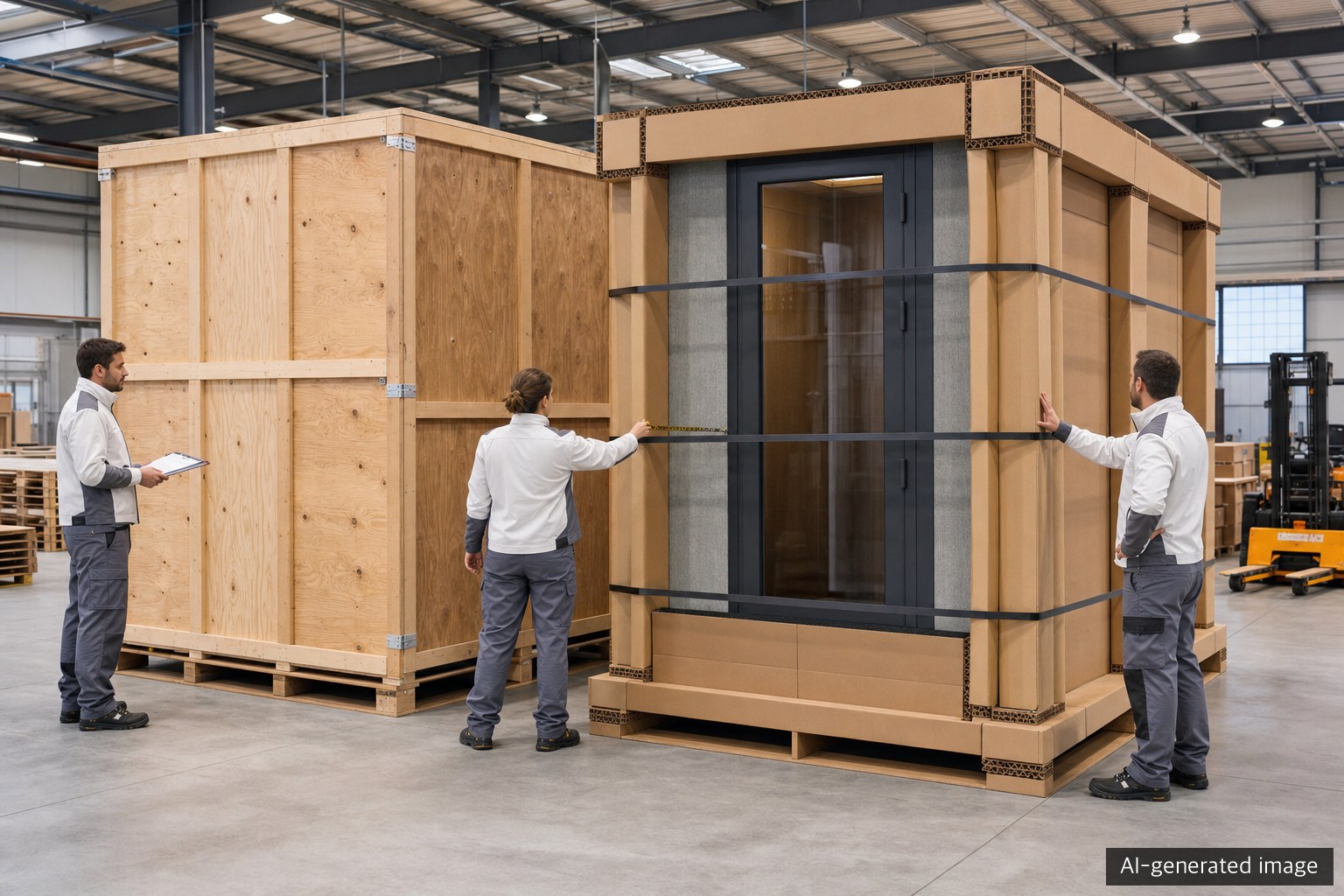
When the first container that switched from wooden crates to corrugated comes back damp at the port, the urgent task isn’t root-causing it — it’s stopping the next shipment. This article is for packaging engineering teams and production managers exporting industrial and heavy goods overseas. It provides a transition test plan table and role-based approval-gate checklist you can apply right away.
What the Mondi/Büromodel Case Tells Us
On July 21, 2026, Mondi announced a case in which it helped furniture manufacturer Büromodel switch to custom corrugated packaging for shipping acoustic office cabins across Europe and other regions. Büromodel had previously built wooden and plywood crates in-house, but faced handling safety, production, and packaging efficiency issues, as well as mold problems during sea transport. The new corrugated structure was reported to offer easier assembly, a stackable design, efficient use of storage space, integration into existing processes, and no need for additional capital investment. According to Mondi’s announcement, material and process costs reduced operational packing costs by about 20%.
That 20% figure, however, is a case result specific to Büromodel — a particular customer with a particular product line — not a general reduction rate or guaranteed figure applicable to every wooden-to-corrugated transition. What this article covers isn’t the repeated claim that “corrugated is cheaper/lighter,” but what to test, in what order, and with whose approval, before actually replacing wooden crates with corrugated.
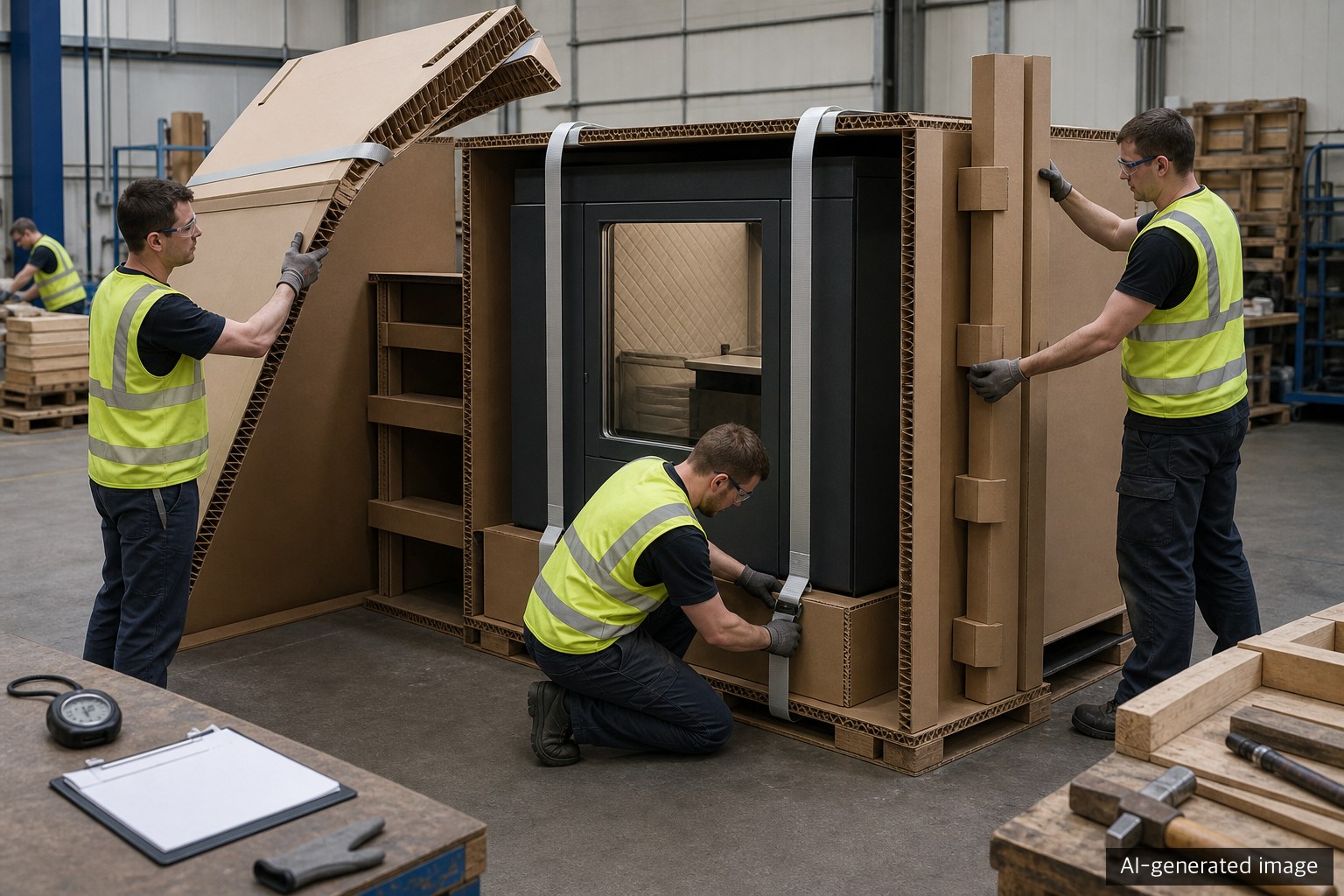
Why a Test Plan Comes Before “Lighter Corrugated”
Wooden crates tend to distribute point loads well, resist sharp edges and forklift forks relatively well, and often withstand long-term storage or repeated returns. Switching to corrugated changes some of these resistance characteristics, so results can vary significantly depending on product weight, center of gravity, and anchor point locations. So don’t decide to transition just because “the corrugated structure is lighter and easier to assemble” — first build a test plan tailored to the actual logistics route (sea transport, number of transshipments), customer specifications (consignee’s unloading equipment, warehouse conditions), and product fragility (surface finish, presence of electronic components).
This article does not arbitrarily specify test condition numbers (temperature/humidity ranges, drop heights, vibration duration, etc.). These should be set as pre-agreed values based on each site’s actual logistics route, customer requirements, and internal approval process — specific numbers should only be cited when referencing a published industry standard.
Transition Test Plan Table
Below are the items to fill in when planning a transition from wooden crates to corrugated. Actual values should be filled in per product and route, and pass/fail criteria should follow each site’s internal standard (pre-agreed value).
| Product/Packaging Version | Product Weight & Center of Gravity | Anchor Points/Fragile Areas | Assembly Time | Work Motions & Tools | Forklift/Unloading Method | Stacking Pattern | Warehouse Temp/Humidity | Sea Transport/Condensation Exposure | Post Compression/Vibration/Drop Observation | Packaging Cost Composition | Verdict | Owner | Action If On Hold |
|---|---|---|---|---|---|---|---|---|---|---|---|---|---|
| Version A (existing wooden crate) | [Enter] | [Enter] | [Enter] | [Enter] | [Enter] | [Enter] | [Enter] | [Enter] | [Enter] | [Enter] | Baseline (control) | [Owner] | N/A |
| Version B (new corrugated prototype) | [Enter] | [Enter] | [Enter] | [Enter] | [Enter] | [Enter] | [Enter] | [Enter] | [Enter] | [Enter] | Pass/hold decision needed vs. internal standard | [Owner] | If on hold, reinforce anchor points and retest |
The key point for the “Verdict” column is not to invent public pass criteria or test-count numbers, but to explicitly follow each site’s internally agreed verdict procedure (a pre-agreed value).
Role-Based Approval Gate Checklist
Packaging Engineering Team
- Confirm each product’s center of gravity and fragile-area locations against drawings, and reflect them in the corrugated structure’s anchor-point design.
- Check condensation/humidity exposure history for the sea-transport leg with the logistics partner and reflect it in test conditions.
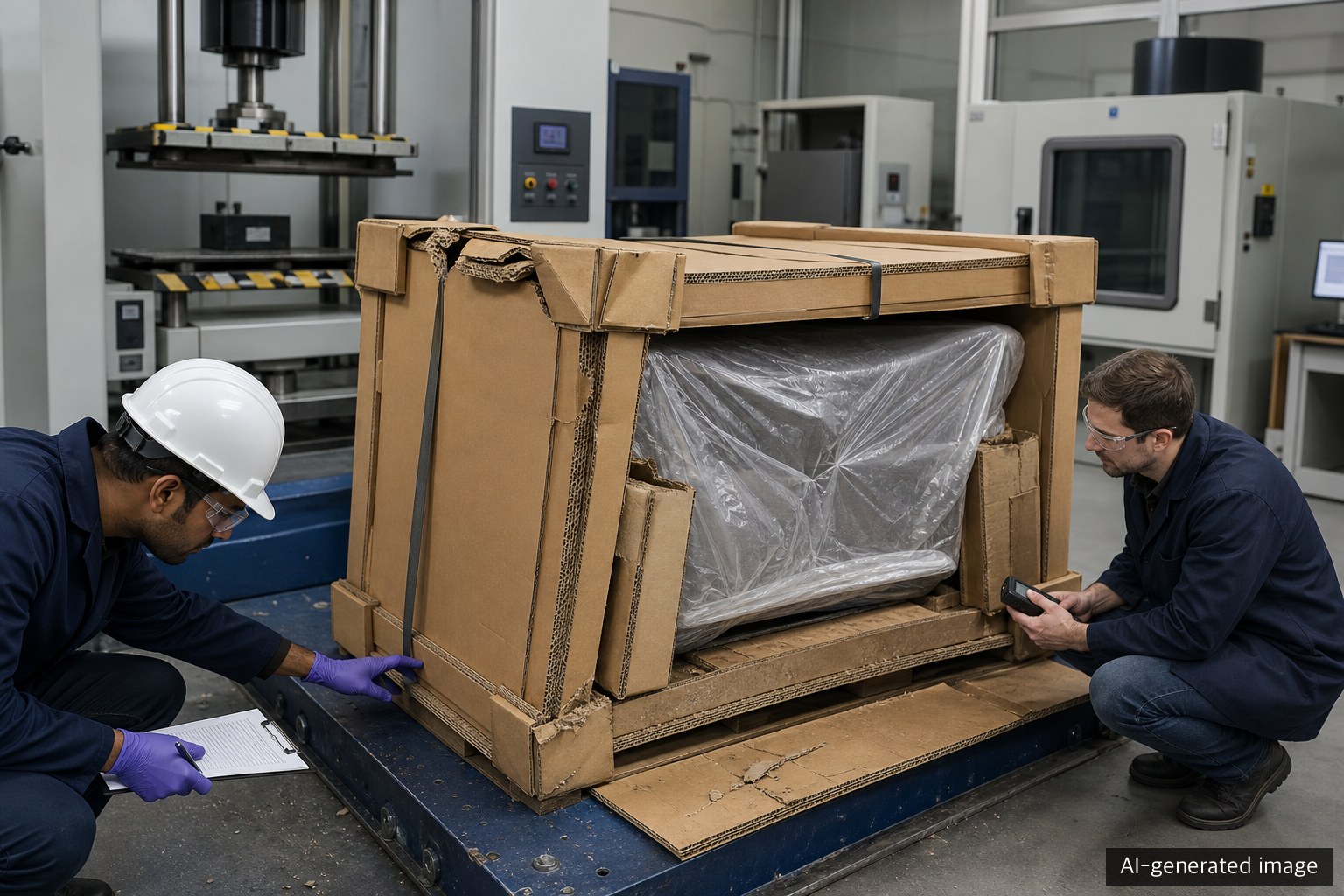
- Record post compression/vibration/drop observation results in photos and video so versions can be compared.
Production Manager
- Measure assembly time and changes in work motions/tools together with floor workers to confirm the design can integrate into the existing line.
- Verify in advance that the forklift/unloading method and stacking pattern match both warehouse and customer unloading equipment.
- Compare packaging cost composition (materials, process, labor) by version to build the basis for a transition decision.
Quality/Logistics Owner
- Immediately place on hold any version that fails to pass the approval gate, and log the hold reason and retest plan.
- Confirm in advance whether the customer contractually requires wooden packaging, in which case the transition review should not proceed at all.
- Add separate test items for product lines with a history of repeated returns or long-term storage.
When Not to Apply This
In the following cases, hold off on the corrugated transition review entirely, or route it through a separate, more thorough review process.
- Products with concentrated point loads or sharp edges
- Products or storage environments with potential exposure to oil or moisture
- Products scheduled for long-term outdoor storage
- Logistics structures requiring repeated returns (returnable packaging)
- Cases where the customer contractually specifies wooden packaging
- Cases subject to rust-prevention, hazardous-materials, or special specification requirements (e.g., military, aerospace)
- Cases that fail to pass the verdict procedure specified in the test plan
FAQ
Q1. Does Mondi’s announced 20% packing cost reduction apply to our company as well? No. That figure is a case result Mondi reported for a specific customer, Büromodel, and a specific product (acoustic office cabins) — not a general reduction rate or guaranteed figure. Results will vary depending on your product’s weight, fragile areas, and logistics route.
Q2. Should the test plan include specific drop heights or temperature/humidity thresholds? Unless citing a published industry standard, don’t invent arbitrary numbers — set pre-agreed values internally based on the actual logistics route, customer specifications, and product fragility.
Q3. Is corrugated always cheaper than wooden crates? No. Comparing material cost alone might suggest so, but total cost of ownership can vary depending on handling safety, whether repeated returns are needed, and special specification requirements. Review this article’s test plan and hold conditions first.
References
- Mondi Group, “Mondi helps Büromodel to cut operational packing costs by 20%” (2026-07-21), https://www.mondigroup.com/news-and-insight/2026/mondi-helps-buromodel-to-cut-operational-packing-costs-by-20/
- Pulp & Paper News, related coverage (2026-07-23), https://www.pulpapernews.com/20260723/18020/mondi-enables-buromodel-cut-operational-packing-costs
About the Author
PackingMaster: Editor of Paper Pack Log. We collect and organize market trends, product information, and technical insights for the paper packaging industry.